
You know immediately when you enter the Museum of the Future in Dubai that that it will not be a conventional museum visit. The lobby alone, which, in many museums, is a bland, functional space, is sixteen meters high and features a curving double-helix staircase with robotic creatures watching from overhead, is a solid indication that visitors will not find staid exhibits or cabinets of artifacts here. This experience is something closer to theater.
Messages Written in Sunlight
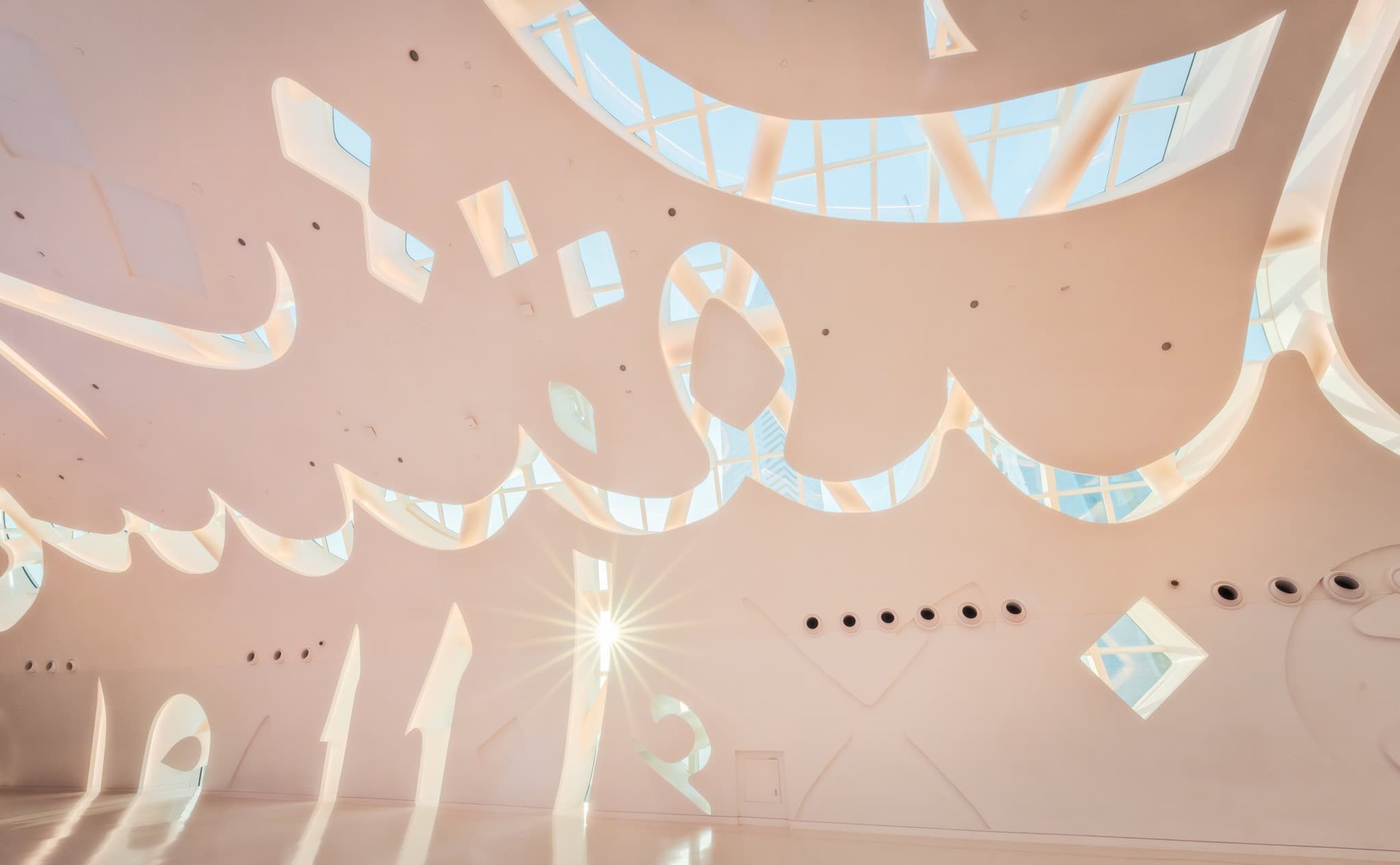
Daria and I were there for the Photopills Exhibition and because of the event, we were able to enter the museum before it opened to the public. We were also taken to the seventh level, which is normally closed to the public. Seeing the building at an early hour before it filled with tourists was an almost otherworldly experience. The calligraphy that adorns the museum’s façade continues inward as light, with the words of Sheikh Mohammed bin Rashid al Maktoum flowing across the interior surfaces in Arabic script. Against the spare, white surfaces, the walls seem to carry messages written in sunlight.
Photographer’s Dilemma
I often photograph architecture. It typically gives me a fixed point to work from, whether that is a particular view, a façade, or an interesting quality of light at a given time of day. But the Museum of the Future is unlike any other structure I have ever photographed, also its exterior at night. It offers none of the fixed points or qualities of other buildings. Every floor of the museum is a different world, beginning with a simulated space station in the year 2071 on the fifth floor, where visitors enter the museum. From there, you descend downward through multiple “chapters,” a rainforest, a meditation sanctuary, the Library of Life, a collection of the DNA of 2,400 species which glows in a darkened room. The light changes and color palettes shift from floor to floor, and the overall effect is that of a building that is somehow a living being.
For a photographer, the museum is fascinating but challenging. Its singular interior offers a multitude of obvious and striking shots, but finding one that is not quite so obvious requires patience. You hang back; you wait. The light changes and the calligraphy moves along the floors and walls. Every now and then, you find a certain quality of light spilling through the museum’s outer shell, or you notice a visitor looking upwards toward the sky, momentarily transfixed by this luminous language.
The Museum of the Future was built in the form of a story and should not be explored at a rushed pace. Allow at least two or three hours to adequately experience the building and its transitory magic.


