
The United Arab Emirates is a federation of seven emirates on the southeastern edge of the Arabian Peninsula, founded in 1971. Abu Dhabi is the capital and by far the largest emirate. Dubai is the best-known city, while Sharjah, Ajman, Umm Al Quwain, Ras Al Khaimah and Fujairah complete the federation. Most visitors split their time between the Dubai skyline, the Grand Mosque in Abu Dhabi and the desert in between.

Sheikh Zayed Grand Mosque in Abu Dhabi
The Sheikh Zayed Grand Mosque was commissioned by the founding president of the UAE, Sheikh Zayed bin Sultan Al Nahyan. It opened in 2007. He wanted it to gather the artistic traditions of the wider Islamic world in one building.
My exterior frame came on the last weekend of my three-week stay in 2025. Andy Marty called with media access, and we drove over from Ajman, more than an hour and a half away. Around 6 a.m., on the first days of Ramadan, we passed a media-only gate. About ten minutes later, I stood at this spot.
The mosque’s lighting follows the phases of the moon, so it glowed a soft blue that morning. Lit golden cubes lead the eye toward the entrance. I shot three bracketed exposures on a 19 mm tilt-shift lens to keep the lines straight. The result is the Grand Mosque in its Ramadan light, empty of visitors.
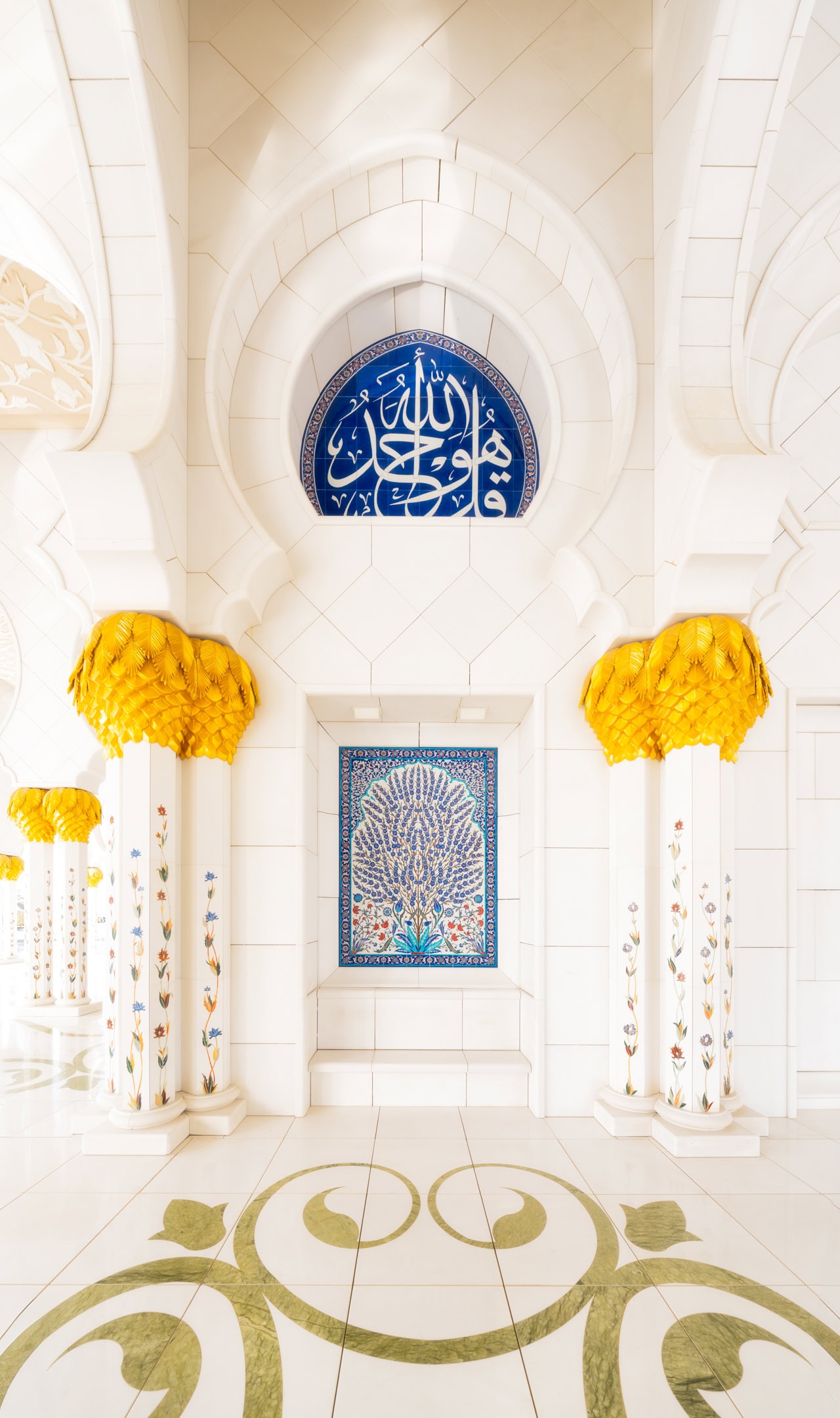
Inside, the detail matters more than the scale. In one arch, a verse in white script sits on deep blue above gold palm capitals and floral marble inlay. That frame of the mosque’s Islamic art is the one I return to.
Photographing the UAE
Access decides what you bring home from the Emirates. The strongest frames here come from rooftops, closed museum floors and a mosque before opening time. None of those are on a tourist ticket.
My first trip, in 2022, lasted barely a week. We flew in after photographing Doha and shot what any visitor can reach. Since early 2025, however, I have co-led the PhotoPills expedition to the Emirates with Andy Marty. That role opens doors, and it changed the work completely.
The first expedition became a three-week stay. During those weeks, I had media access to the Sheikh Zayed Grand Mosque. I also shot from the Shangri-La rooftop and a private balcony above Sheikh Zayed Road. Later visits then added the Museum of the Future before opening and the highest outdoor infinity pool in the world.
Most of this guide therefore comes from those mornings and nights. It covers Dubai, Abu Dhabi and the Sharjah desert. For the city in depth, see my full guide to Dubai.
Downtown Dubai and the Burj Khalifa
Downtown Dubai is the centre of gravity for most first visits. Developer Emaar built it around the tower, and the district was finished in 2017. Arabian-style low-rise buildings line its canals, while the towers rise straight behind them.
We found one of my favourite views of it by accident. While walking past the restaurants of the Old Town, we turned into a turquoise canal leading straight to the tower. The traditional facades on both sides frame the spire like a gate.

The Burj Khalifa itself opened in 2010 at 828 metres. It was designed by Skidmore, Owings & Merrill. It started as Burj Dubai. However, it took the name of Sheikh Khalifa after Abu Dhabi supported Dubai through the financial crisis.
In my daytime frame, it rises above a pool with lily pads and a single pink lotus. The whole district becomes the foreground of one building, and that is exactly how Downtown feels on the ground.

Moon Alignments over the Burj Khalifa
Every PhotoPills expedition builds toward one shot: the full moon aligned with the spire of the Burj Khalifa. We plan the exact spot with the PhotoPills app, days ahead. Even so, the weather still has the final say.
In 2025, clouds rolled in as the moon approached the spire. Our mantra became “plan and pray”. Then, just at the right second, a hole opened and the supermoon sat behind the spire, framed by those clouds.
The best frame of that trip, though, came after the hero shot. As the moon drifted right of the tower, one of the neighbouring buildings looked like a platform. I repositioned with a 175 mm lens and waited until the moon rested on the skyline like a golden orb. Most viewers notice the tower first and find the moon only later.

In 2026, the sky stayed clear. As the moon met the spire, the rising sun was already lighting the lower floors. That full moon over the Burj Khalifa at dawn shows texture on the tower that a night alignment never can.

Museum of the Future
On my first trip in 2022, the Museum of the Future had only just opened. Tickets were booked out a month ahead, so I never saw the inside. Three years later, I came back for the outside first.
The view finally came from a private balcony where only two people can shoot at once. This far south, blue hour lasts ten to fifteen minutes, not the long dusk of Berlin or Lisbon. I blended five exposures, so the traffic draws gold streaks past the museum at night. The Emirates Towers rise behind it.
On a later visit, we entered before the public. Inside, the calligraphy of the facade turns into moving light. It drifts across the white walls of the museum’s interior, so the best frame changes by the minute.
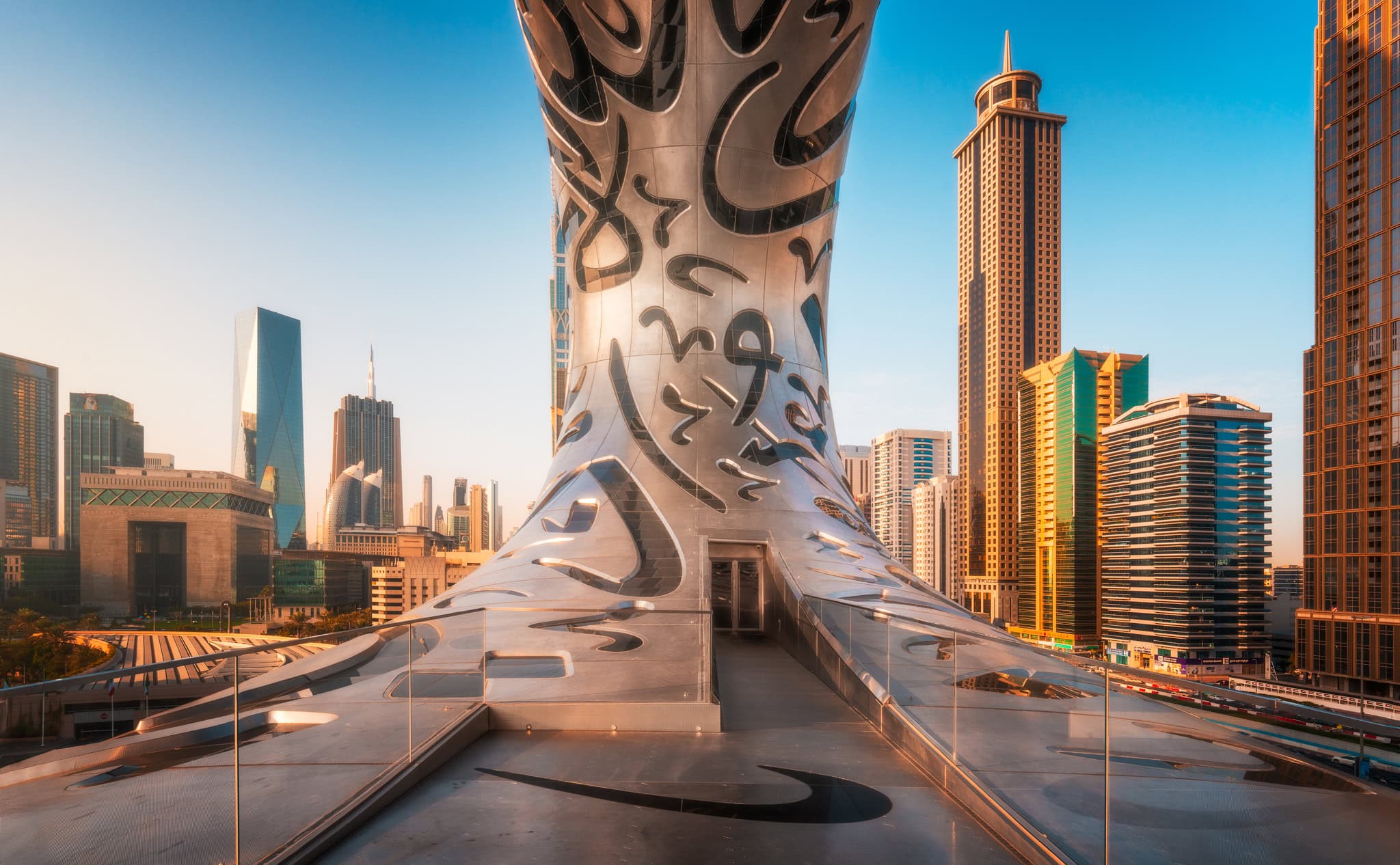
Outside, by contrast, the building is a steel ring by Shaun Killa, wrapped in Arabic script that doubles as its windows. From the terrace of the observation level, the ring rises right beside you. Meanwhile, the financial district towers stand all around.

Dubai from Above
Dubai is a rooftop city, and the right roof decides the photograph. Andy Marty knows these roofs like few others. On two mornings, he brought our group to the terrace of the Shangri-La Hotel.
The first time, we arrived straight from a night of moon work. I swapped lenses and ran upstairs, just as the sun broke through the dust. The result is Downtown Dubai at sunrise, gold below and blue above.
The second time, a fog forecast had us on the road at 2:30 a.m. Instead of fog, we got low clouds wrapped around the skyscrapers. A two-second exposure at 17 mm turned the highways into rivers of light in Downtown Dubai at night. It became one of my favourite frames of the whole trip.

Haze works the same way. On a winter morning near Palm Jumeirah, the dust hid everything except two peaks. As a result, the Burj Al Arab and the Burj Khalifa float in the haze. A single cloud sits above them.

The highest roof of all is the 77th level of the Address Beach Resort. Its pool holds the Guinness record as the highest outdoor infinity pool, at 293.9 metres. We stayed from dark until sunrise. Then I wedged myself between the pool and the glass wall for the infinity pool at first light.

Dubai Marina and Internet City
Dubai Marina sits about 25 kilometres southwest of Downtown, along the coast. It is one of the largest man-made marinas in the world, built in phases. Today, yachts run between towers, and the promenade fills up in the evening.
My frame of the Marina canal in late afternoon shows one yacht cutting through it under a pink sky. Before booking a hotel, though, we weighed Downtown against this side of the city. The deciding factor was simple: how many sunset locations lay within walking distance.
Internet City won the argument. It is a free zone that opened in 2000, home to tech firms from all over the world. On our first evening, just in from Qatar, I was not even planning to shoot. Daria talked me into taking the camera.
Five minutes from the hotel, however, the tripod came out. I spent the rest of the night on the lake in Internet City. Its fountain rises in front of the lit Marina towers.

Dubai Creek
Dubai began on the creek. The Bani Yas tribe settled here in the 19th century. Since then, the Al Maktoum family has ruled from the creek. Before oil, pearl diving and fishing ran the town.
The creek still divides Deira from Bur Dubai. Wooden abras carry commuters across, and old wind-tower houses line the water.
We crossed it in two boats with the workshop group. I noticed a sailing boat I had never seen before, but gave it little thought. Shortly after, Andy texted from the other boat: “Did you see the movie set?”
I asked our driver to turn around. Old tools, aged crates and rustic props filled the waterfront, dressed as a historic market for a film. The result is Dubai Creek as a set from another century, with the boat white sail against the wind towers.

Al Madam in Sharjah
Al Madam lies in the Sharjah desert, about an hour’s drive from Dubai. It was built in the 1970s as housing for local families. Then it was abandoned, and nobody has given an official reason since.
Since then, the desert has been moving back in. Dunes spill through doorways and fill the rooms one grain at a time. The village does not feel dramatic. Instead, it feels paused.
My hero frame is a sand-filled threshold, shot at f/8 and 1/500 s to keep every ripple sharp. A doorway should draw a hard line between inside and outside. Here, that line has dissolved, and the sand runs straight through.
The rest of the Al Madam series follows the same idea. It shows a tower through a window, a room of window light and quiet walls under open sky. Side light on sand turns plain rooms into landscapes, which is why these frames work as prints.

Desert, Camels and Falcons
Long before the towers, the desert set the rules of life here. The Bedouin built their whole way of life around the camel. It gave them transport, milk, food and the material for tents.
Genuine nomadic Bedouin are now essentially gone from the Dubai area. Camels, on the other hand, are easy to find, because camps set up for exactly this kind of shoot. On the expedition, we hired a handler and his camel and predicted where the sun would set.
Our model, however, wanted to get back to the herd for dinner. So the trick was to angle the camel toward camp, otherwise it kept turning. Then I set up close and framed the handler and his camel at sunset. They face each other, with the sun between them.

The falcon carries the same heritage. Falconry began as a way to hunt for food, and it is now a national passion. UNESCO lists it as a living human heritage, in a nomination the UAE led.
My frame of a peregrine falcon came unplanned during the 2025 expedition. In a dive, this bird passes 320 km/h, faster than any other animal.

When to Visit the UAE
The season runs from November to March. Days are warm, nights are cool, and the desert is pleasant to walk. From June to September, by contrast, daytime heat regularly passes 40°C.
Winter is also when fog and haze appear, especially at dawn. Both form overnight and usually lift by mid-morning, so a hazy sunrise needs a rooftop booked the night before. Summer haze is heavier and longer, while sandstorms are a different event entirely. Check the forecast before every session.
Ramadan moves about eleven days earlier each year. During the month, the Grand Mosque’s lighting changes with the moon, and opening hours shift. Eating and drinking in public during daylight is also best avoided.
Finally, plan for short twilight. Blue hour lasts minutes, not the half hour of a European evening. Be set up before sunset, not at it.
Frequently Asked Questions
What is the best time to visit the UAE?
November to March is the best time to visit the UAE. Daytime temperatures are warm rather than extreme. In addition, winter mornings bring the fog and haze that photographers plan around. Summer, from June to September, regularly passes 40°C, which limits time outdoors to early morning and night.
How many days do you need in the UAE?
A week covers Dubai, a full day in Abu Dhabi and an evening in the desert. Ten days or more gives you time to wait for weather, which matters for moon alignments, fog and haze. Our expedition stays have run up to three weeks, and the best frames came late in that time.
How far is Abu Dhabi from Dubai?
Downtown Dubai and central Abu Dhabi are roughly 140 kilometres apart. That is about an hour and a half by car. Intercity buses also run between the two. Because the Grand Mosque sits on the Dubai side of Abu Dhabi, it is the easiest major sight for a day trip.
Is it free to visit the Sheikh Zayed Grand Mosque?
Yes. Entry to the Sheikh Zayed Grand Mosque is free, but visitors book a time slot on the mosque’s official website. A modest dress code applies: arms and legs covered, and women also cover their hair. Opening hours change during Ramadan and on Fridays, so check them before you travel.
Can you photograph people in the UAE?
Only with permission. UAE law treats photographing people without their consent as an invasion of privacy. The penalties include fines and prison. Architecture and landscapes are fine, and hired subjects such as a camel handler are fine. Strangers in markets or on the street are not.
How do you get to Al Madam?
Al Madam lies in the Sharjah desert, roughly an hour by car from Dubai. There is no entrance fee and there are no facilities on site, so bring water. The sand looks best in early morning or late afternoon, when low side light reveals every ripple.
What are the seven emirates of the UAE?
The seven emirates are Abu Dhabi, Dubai, Sharjah, Ajman, Umm Al Quwain, Ras Al Khaimah and Fujairah. Abu Dhabi is the capital and the largest by area. Dubai is the largest city. Each emirate has its own ruler, and together they form the federation founded in December 1971.


