
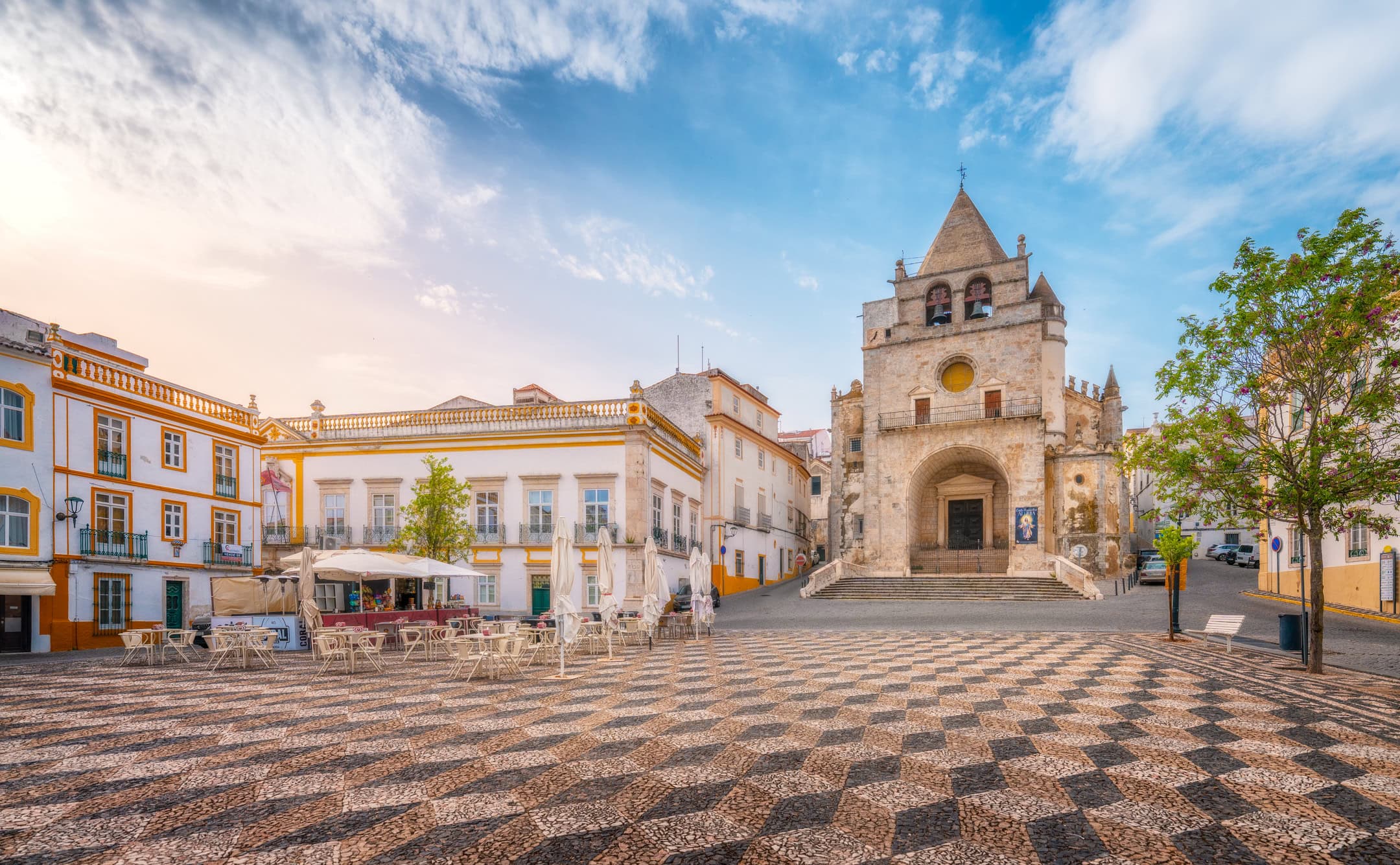
Elvas Cathedral stands out in the historic city center of Elvas, framed by the intricate Portuguese pavement of Praça da República.
I’d been wanting to photograph the buildings and pavement in the square since I visited Elvas for the first time, but I couldn’t before because there was a market taking place. It looked very different, full of booths with local artisans and products (which wasn’t so bad, I got myself some honey from the region).
But the second time, I was blessed with a beautiful sunset and no market at all, so I was able to capture the cathedral inside the mystical context of Elvas, a city named by UNESCO as a World Heritage site.
The former Elvas Cathedral at Praça da República
Technically, Elvas Cathedral is not a cathedral anymore. It held that status only until 1881, when the diocese was dissolved, but the name “cathedral” has stuck ever since and locals and visitors alike still refer to it that way. Officially, the church is called Igreja de Nossa Senhora da Assunção.
The cathedral was designed by the royal architect Francisco de Arruda, the same master builder behind the city’s Amoreira Aqueduct. The fortress-like architecture reflects the defensive character of a city that spent centuries guarding Portugal’s border.
The Praça da República around Elvas Cathedral is the natural starting point for any visit and the axis where Elvas’s daily life still unfolds. I actually have two photos from Praça da República, with the other one showing the Casa da Cultura on the opposite side.
The intricate beauty of Portuguese pavement
What I find particularly striking about Praça da República is the patterns in the pavement, so typically Portuguese. Even before you reach the Elvas Cathedral steps, the ground itself demands attention.
Portuguese pavement, known locally as calçada portuguesa, is a traditional mosaic technique that uses small cubes of limestone and basalt arranged into geometric or wave-like patterns. This style turns ordinary pedestrian areas across Portugal into real works of art.
In Elvas, you have the patterns in three colors, instead of the usual black and white seen in most places. Here you have a sort of reddish tone in the pavement that makes it especially three-dimensional, even a little bit hypnotic.
If you want to give Portuguese pavement more prominence in the photo, keeping a low angle usually produces some of the most striking images, thanks to the visual effect of the pavement stretching toward the surrounding buildings or sculptures.
Some of my favorite examples of Portuguese pavement include the Praça de Carlos Alberto in Porto, with a unique line design, the Square of 5th October in Cascais with a wavy pattern, and the pavement in front of Setubal Town Hall, incidentally my second favorite city in Portugal (after Lisbon!)
For the rest of the region, from Évora to Mourão, see my Alentejo travel guide.


