
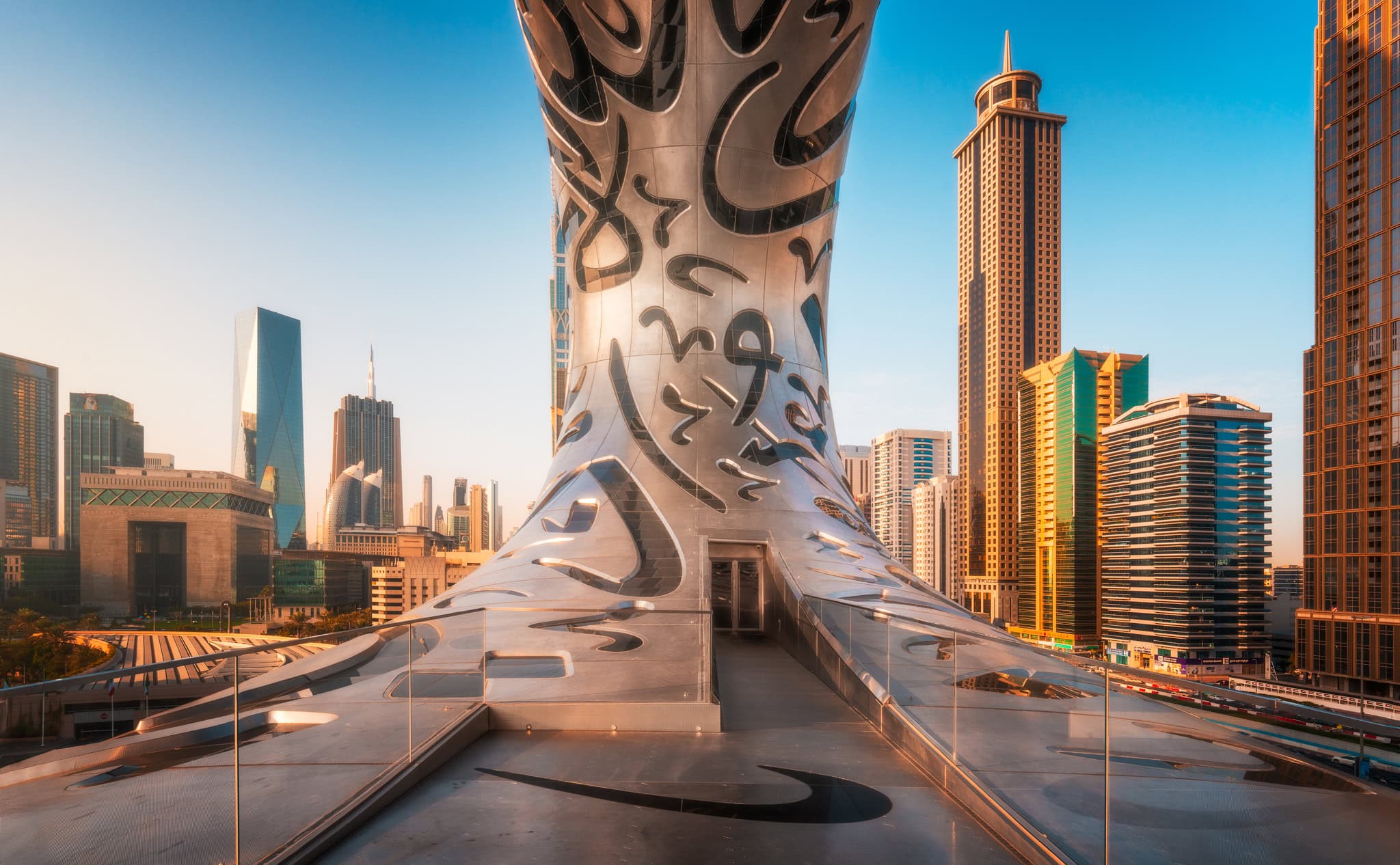
In a city known for its remarkable, laws of physics-defying architecture, there is no shortage of buildings that ask you to look at them. The Museum of the Future, however, is different; it asks you to look through it, a distinction that is the building’s entire point.
A Striking Design of the terrace of the Museum of The Future
Designed by Shaun Killa of Killa Design and engineered by Buro Happold, the building was constructed in a ring shape, something akin to an oblong doughnut perched on its side, with its surface, all seventy-seven meters, clad in more than one thousand fire-retardant panels faced in stainless steel. Each panel is a unique 3D form, and across their surface runs more than 14,000 meters of Arabic calligraphy, the ornate script spelling out the words of Dubai’s ruler Sheikh Mohammed bin Rashid Al Maktoum. His words are not mere decoration; they form windows, words about the future cut into steel and framing views of one of the world’s most modern cities.
Everything about the building carries meaning. The green landscaped hill on which the building was constructed represents the earth; the stylized torus that is the building itself represents humanity; and the void in the building’s center symbolizes the unknown.
Dubai prides itself on its remarkable architecture. It is a city where futuristic aesthetics combine with elements of traditional Arabian design and are brought to life in a language of near superhuman excess. This building, though, is remarkable, even in a city of superlatives. Even before the museum’s 2022 opening, National Geographic decreed it one of the most beautiful museums on Earth. It is not only beautiful; built with no interior columns, but it is also an engineering wonder.
An Awe-Inspiring Interior
The building’s remarkable construction means that visitors have an unobstructed view of the city. There is nothing between the viewer and the city beyond except the incredible artistry of the building’s singular façade.
The Museum of the Future sits on a grassy hill that is adjacent to the Emirates Towers, among one of the most remarkable concentrations of contemporary architecture in the world. It is at once both the newest addition to the city’s improbable skyline and a homage to its history. Very appropriately, the calligraphy that adorns the building’s façade translates to “The future belongs to those who can imagine it, design it and execute it. It is not something you await but rather create.”
The museum is spectacular at any time of day, but I was fortunate enough to arrive early one morning, when it was largely empty. Without other visitors, I had the remarkable structure to myself and was free to wander and marvel.
For more rooftops and viewpoints across the country, see my UAE photography guide.


