
Ireland is an island on the western edge of Europe, across the Irish Sea from Great Britain. Most of it forms the Republic of Ireland, while Northern Ireland, in the northeast, belongs to the United Kingdom. Dublin, the capital, lies on the east coast where the River Liffey meets the sea. Across the island, the limestone hills of County Clare end abruptly at the Atlantic.

Cliffs of Moher
Our Ireland archive comes from one trip in summer 2023, our first on the island. Daria and I spent eight days there with a Sony A7R V. We started in Dublin, then drove west to County Clare for two evenings at the cliffs.
On 2 August, wind and rain showers followed us along the path. Shortly before sunset, however, the clouds finally broke. At 21:09, I opened the shutter for 160 seconds at 45mm and f/8. As a result, the long exposure at sunset turned the Atlantic into smooth swirls around the sea stack.
From Hag’s Head in the south, the cliffs rise northwards from about 120 metres. They reach 214 metres just north of O’Brien’s Tower. Below the tower, meanwhile, stands Branaunmore, a sea stack about 67 metres high and full of nesting seabirds.
O’Brien’s Tower
Sir Cornelius O’Brien, a local landowner, built the round stone tower in 1835 as a viewing point for visitors. Seen from the southern path, it looks tiny on top of the cliff wall. That contrast in scale is what I came back for on the second evening.
On 3 August, I found my composition, and then the rain poured down. So I covered the camera and waited. At 20:30, about 20 seconds after the rain stopped, the sun broke through. The wind made a tripod useless, so I shot the edge of the cliffs in golden light handheld at 1/80s. Meanwhile, wet grass and the green ledges took the low light from the west.

Doonagore Castle
Earlier that same afternoon, we walked up from Doolin, a village a short drive north of the cliffs. Stone walls line the roads here, so there is nowhere to stop a car. Instead, we parked in the village and went on foot.
Doonagore Castle is a round tower house from the 16th century, restored in the 1970s. Today, however, it is a private home and closed to visitors. While I searched for a frame, a group of cows came to a farm gate and lined up along it. At 18:04, I shot the castle above its curious audience at 62mm and f/13. Because of that depth of field, both the cows and the tower stay sharp.

Dublin
Our trip, though, began on 29 July in the capital. In the first 24 hours, I walked 31,000 steps. Even so, the city gave us sun on the first afternoon, which in Ireland is never a given.
That Saturday afternoon, I followed the river west and stopped opposite James Gandon’s domed courthouse. The Four Courts across the Liffey is a 12mm frame that follows the curve of the quay wall. The building houses the Supreme Court, the Court of Appeal and the High Court. In June 1922, at the start of the Civil War, fire gutted it.
I enforce copyright on my own work across Europe, so a country’s highest courts hold my attention. Our Dublin city guide covers the capital in depth. This page, therefore, gives the country view and the story behind each frame.

Temple Bar
That first evening, I met Anthony, a local photographer, at the Ha’penny Bridge. He gave me one tip: shoot Temple Bar on a Sunday at dawn. Pubs in Dublin close earlier than in Germany, so by morning the streets are empty.
On Sunday, 30 July, I was out before six. At 06:03, sunrise lit the portico of City Hall at the top of Parliament Street. Thomas Cooley designed it as the Royal Exchange, built between 1769 and 1779. It has since become the seat of Dublin City Council.

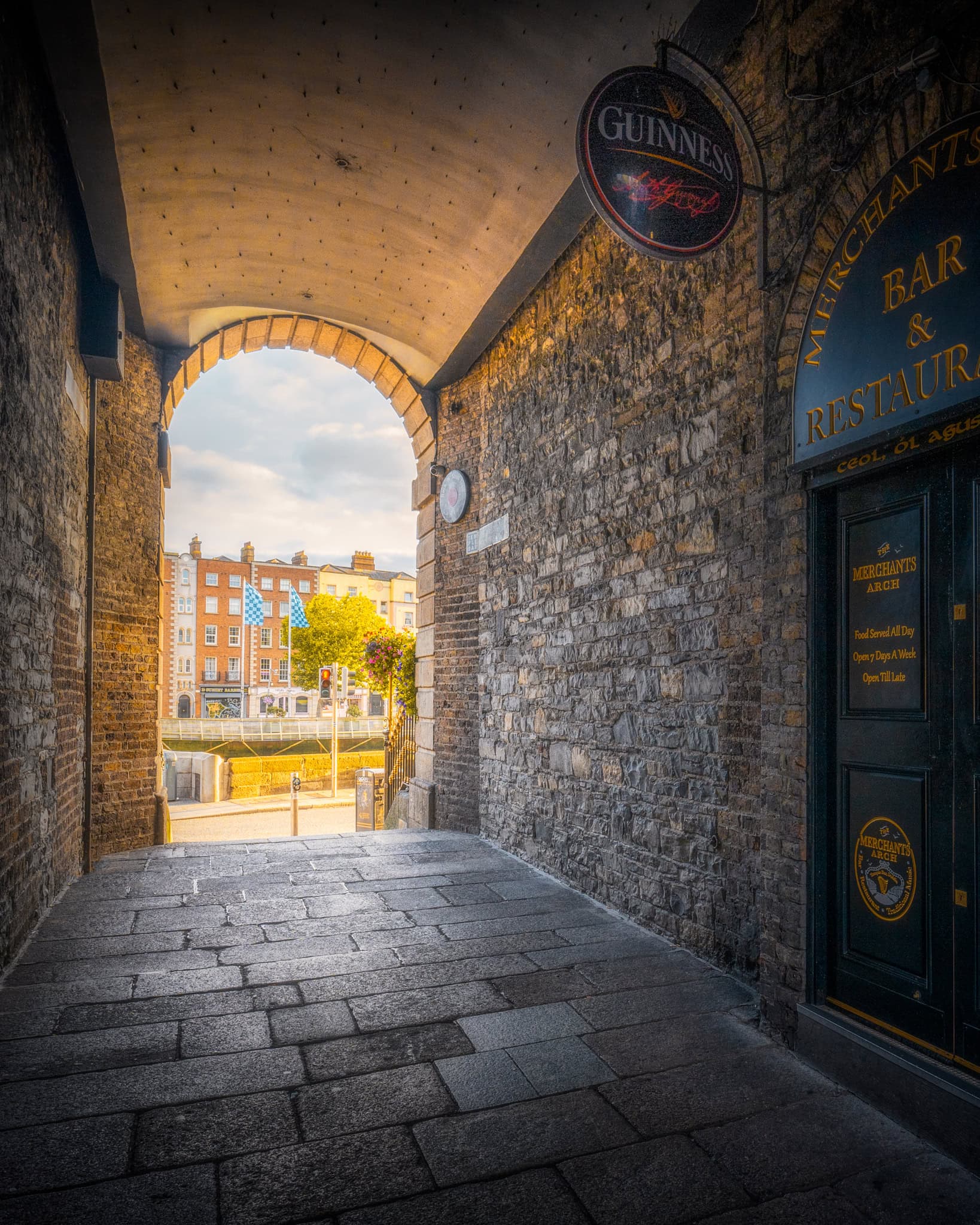
Fifty minutes later, I stood at the river end of Merchant’s Arch. Frederick Darley designed this hall for the Merchants’ Guild from 1821. Its passage is a public right of way between Temple Bar and the bridge. Through it, the arch frames the Liffey at dawn, with warm light on the houses of the north quays.
Four minutes after that, I reached The Temple Bar pub at sunrise. Its red front glowed, and the lamps were still on from the night before. Meanwhile, not a single person crossed the street. A few minutes later, the first rain started.

Ha’penny Bridge
On Sunday evening, Dublin celebrated. Earlier that day, the county team had beaten Kerry in the All-Ireland football final. Fans streamed across the Ha’penny Bridge, and the cast-iron deck shook under every step.
The bridge first opened in 1816. Its name comes from the halfpenny toll once charged to cross it. The night before, I had noticed a broken green light under its left side. This time, I saw what it could do. Green light glowed on the left, the bridge shone white in the middle, and streetlights burned orange on the right. Together, they formed the Irish tricolour in the water.
Each exposure ran 60 seconds at f/16, and every group of fans set the deck moving again. After six attempts, at 22:48, the reflection held still. The Ha’penny Bridge in the colours of the flag is the result.

Christ Church Cathedral
Christ Church stands at a busy crossing, with traffic lights, signs and buses on every side. For days, I walked past it and found no clean frame. On 1 August, however, I came back from the river at blue hour. When a bus passed, I stopped fighting the traffic and used it.
At 22:03, I set the tripod at the bend of the road and exposed for 30 seconds. Bus lights then drew lines of light past the cathedral and under the covered footbridge. George Edmund Street added that bridge in his 1870s restoration. It links the cathedral to the former Synod Hall, now Dublinia, a museum of Viking and medieval Dublin.

Maynooth
On Saturday, 5 August, we drove back east to fly home to Portugal. Maynooth lies about 25 km west of Dublin, so we stopped there for lunch. After a dessert, we waited for one more rain cloud to pass.
St Patrick’s College was founded in 1795 as a Catholic seminary. Maynooth University grew out of it and became a separate university in 1997. Behind the gates, the old South Campus stays quiet on a summer weekend.
At 15:22, the sun lit St Joseph’s Square under a broken sky. A straight path leads to the Gothic Revival buildings, with roses along the lawns. To the right, the spire of the college chapel rises above the trees. I framed it at 24mm so that the whole avenue fits.

Photographing Ireland
Ten frames from eight days is a small archive. Still, the numbers show where the value sits. City Hall brings the most clicks from Google Images, with 32,000 impressions in the last 90 days. That frame exists only because a local photographer told me when the streets would be empty.
The real surprise is Maynooth. An afternoon stop on the way to the airport collected 42,800 web impressions in the same period. That is more than all our Dublin pages together. People search for the university by name, and few photographers ever go there.
The weather sets the rhythm of any trip here. In fact, it rained at some point on almost every day. Both cliff frames, however, came from the minutes right after a shower.
When to Visit Ireland
We travelled at the end of July and early August. Sunset came around 21:15, and sunrise before 6:00. As a result, the best light sat at the two ends of very long days.
By contrast, the sun sets before 16:30 in December, and storms often close the coastal paths. May to September brings the longest days and the mildest weather. Rain, however, comes in every season. Showers usually pass within the hour, so a wet afternoon can still end in clear light.
Getting Around Ireland
Most visitors land at Dublin Airport, about 10 km north of the city centre. From then on, we walked everywhere in Dublin. For the west, a rental car gives the most freedom. Ireland drives on the left, and many country roads are narrow, with stone walls on both sides.
The drive from Dublin to the Cliffs of Moher takes about three and a half hours. By contrast, Galway and Shannon Airport are both roughly one hour away. Since 2015, the cliffs and the Burren have formed a UNESCO Global Geopark. The visitor centre sets the opening hours and parking fees for the main viewing area.
For another city across the Irish Sea, our guide to England covers London from the Thames to Greenwich.
Frequently Asked Questions
What is the best time to visit Ireland?
May to September brings the longest days and the mildest weather. In late June, the sun sets close to 22:00 in Dublin, and even later on the west coast. July and August are the busiest months. Rain is possible in every season, but summer showers usually pass quickly.
How many days do you need in Ireland?
Three days cover Dublin at a good pace, including Temple Bar, Christ Church Cathedral and the river quays. A trip to the west coast adds at least two more. We spent eight days: four in Dublin, two evenings at the Cliffs of Moher, and a final stop in Maynooth.
Can you visit the Cliffs of Moher as a day trip from Dublin?
Yes, but it is a long day. The drive takes about three and a half hours each way, and many coach tours run from Dublin. For photography, however, staying nearby is better. Doolin is a few minutes away by car. As a result, you can stay for sunset and come back if the weather turns.
Is Ireland part of the United Kingdom?
No. The Republic of Ireland is an independent country and a member of the European Union. Northern Ireland, in the northeast of the island, is part of the United Kingdom. There are no border checks between them. The Republic uses the euro, while Northern Ireland uses the pound sterling.
Do you need a car to travel around Ireland?
Not for Dublin, which is compact and easy on foot. For the west coast, a car gives the most freedom. Buses reach the Cliffs of Moher, but not every viewpoint. Ireland drives on the left. Many rural roads are narrow and lined with stone walls, with few places to stop.
Is Ireland in the Schengen Area?
No. Ireland is in the European Union but not in the Schengen Area. Instead, it shares a Common Travel Area with the United Kingdom. Travellers arriving from Schengen countries pass a passport check at Dublin Airport. Citizens of the European Union can enter with a national ID card.


