
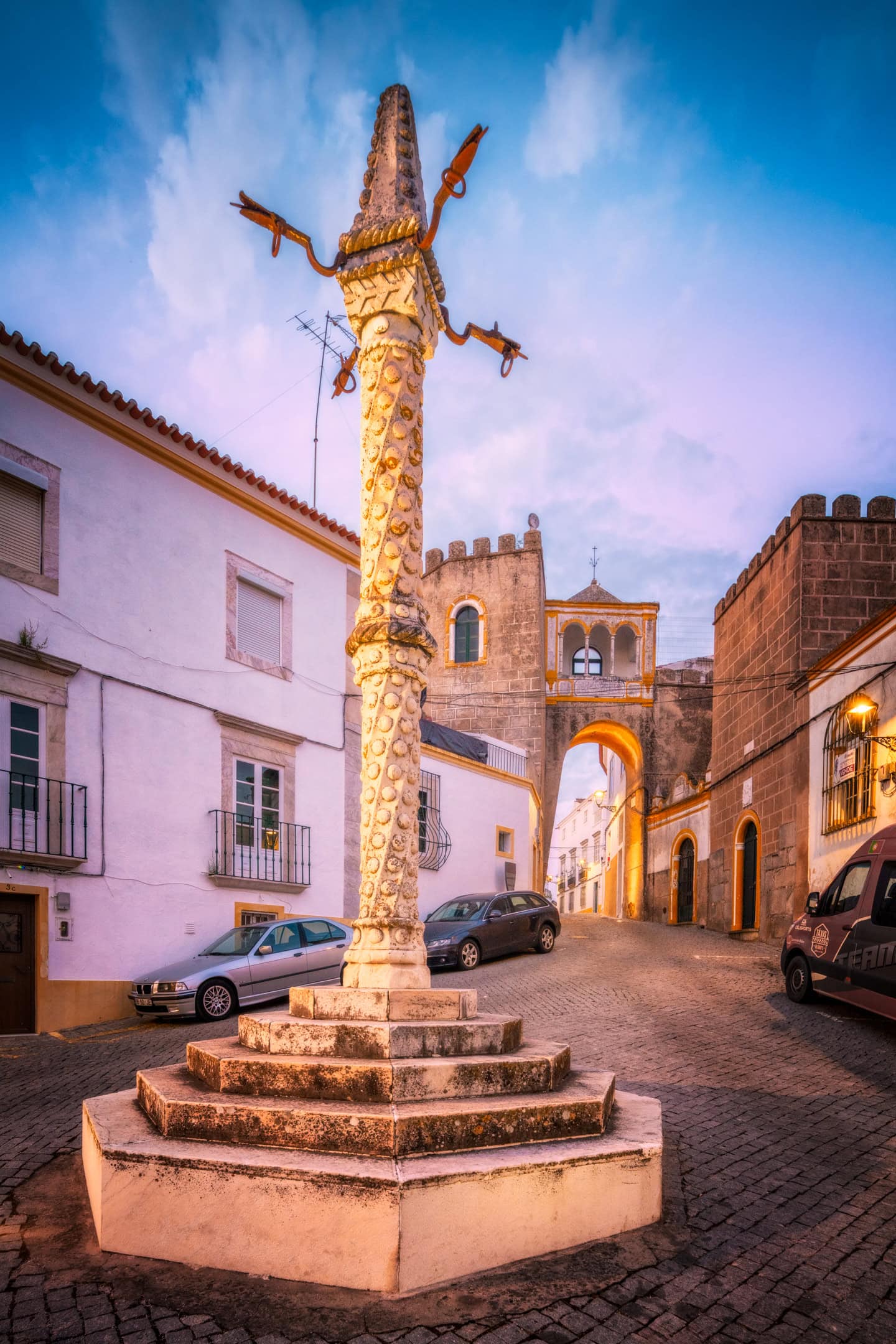
The Pelourinho in Elvas is a Manueline-style landmark that reflects the history of municipal authority in Portugal.
This was the first time I saw a pillory in Portugal. Obviously, it’s not the most wonderful of sights to behold, considering the rather gruesome history behind it. But it is still, all things considered, beautifully designed.
The original Pelourinho once occupied Elvas’s Praça da República before it was dismantled. Later, architects reconstructed the pillory in Largo de Santa Clara using original pieces, and today it continues to be part of the rich legacy of the city.
In case you don’t know what a Pelourinho is
A pillory was a public monument where offenders could be exposed to punishment, and its presence was intended to remind residents of the consequences of breaking the law. So it was a lot more than just a decorative column. A Pelourinho is the Portuguese term for a pillory. From the Middle Ages onwards, these stone columns were erected in Portuguese towns that had been granted municipal jurisdiction to mark the community’s legal independence. In Portugal, while criminals could occasionally be displayed at the pillory, historians generally agree that its symbolic role outweighed its punitive one. The monument functioned primarily as a visible reminder of municipal autonomy and royal authority.The traces of Manueline architecture in Portugal
The Elvas Pillory is an excellent example of Manueline architecture, Portugal’s uniquely decorative Late Gothic style. Although the Pelourinho is much smaller than famous Manueline monuments, it displays characteristic features of the style through its spiral shaft, ornamental detailing, and carved stonework. This is part of the reason I decided not to take the photo with the Church of the Dominicans in the background, but instead I focused on the beautiful little arch that spans the street, the Arco de Santa Clara. A lovely example of the typical architecture of the region. Some of Portugal’s finest examples of Manueline architecture include the Jerónimos Monastery and the Belém Tower in Lisbon; as well as the Batalha Monastery and the Pelourinho de Sintra.What else to see in Elvas
The Pelourinho is just one of many historic landmarks scattered throughout Elvas. Enter the old town through historic gates like Porta da Esquina, and explore Praça da República, the heart of the historic centre and home to the former Cathedral and Casa da Cultura. For panoramic views, climb to Elvas Castle. And of course, you can’t miss the city’s most striking feature and an engineering masterpiece, the Amoreira Aqueduct.For more towns and castles nearby, see my guide to the Alentejo.


