
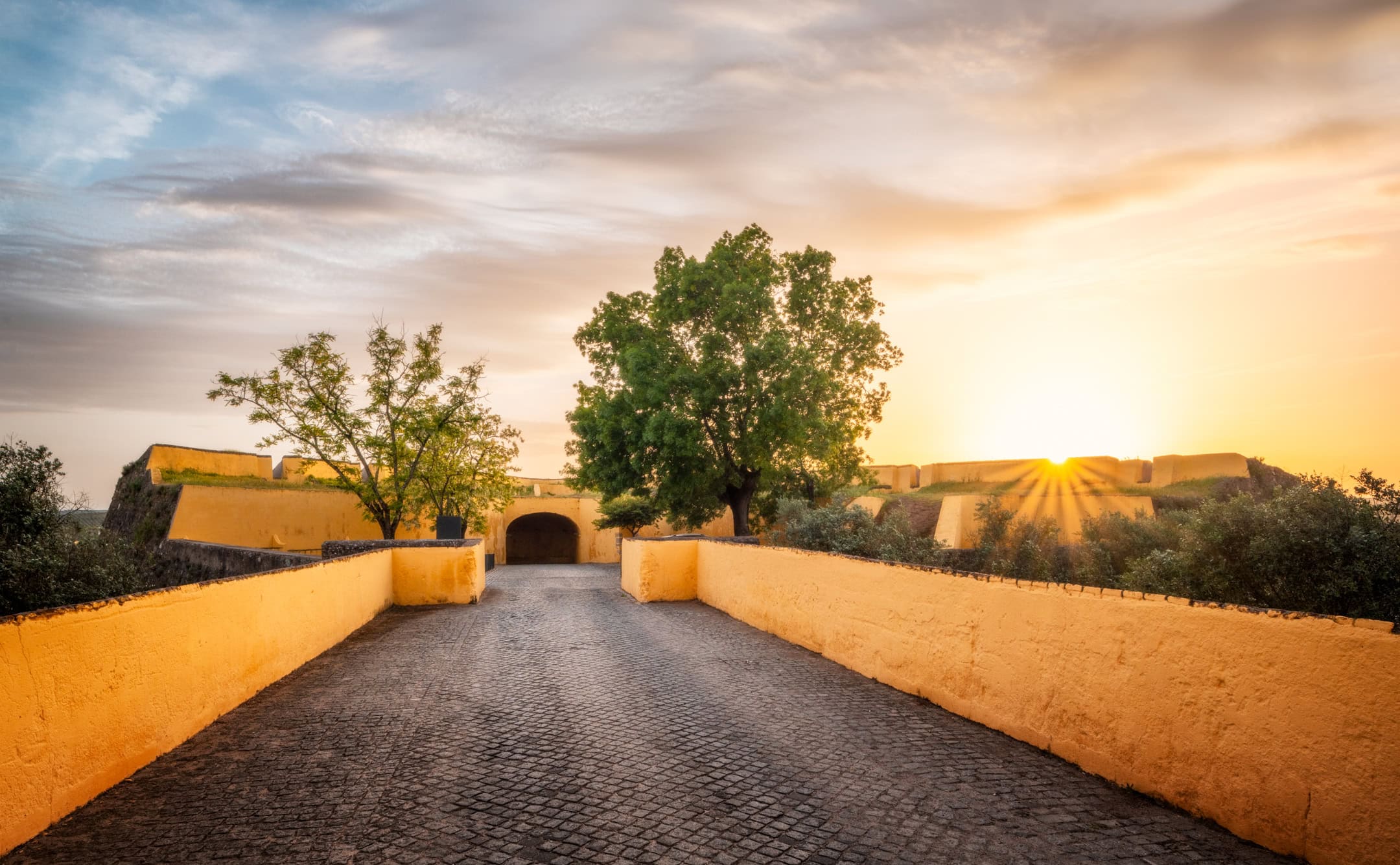
Porta da Esquina is one of the historic gates leading into the fortified city of Elvas, with a distinctive angled passage that reflects the defensive character of the city.
Believe it or not, this is the way you enter the city of Elvas when you drive there. The first time I saw this gate, I found it fascinating and scary at the same time. As I was already approaching it with my car, I noticed that it’s really narrow, with just enough space for one car, yet it serves traffic in both directions.
The gate is a telling piece of a much larger story: the transformation of Elvas from a modest town in Portugal into one of Europe’s top examples of star fort architecture, next to Palmanova in Italy and Naarden in the Netherlands.
Driving through Porta da Esquina
Unlike a straight gateway that would expose defenders to attackers, Porta da Esquina forces anyone entering to make a sharp 90-degree turn inside the passage, that’s why its name literally means “corner gate”.
The entrance actually consists of two separate gates connected by a raised causeway, requiring visitors to pass through an outer gate before reaching the inner one and making it easier for defenders to control access. Today, Porta da Esquina remains a functioning entrance into Elvas, and driving through it is an experience that many of us never forget.
The first time I came to the town, I approached the gate and I saw nothing. I had no idea how long the gate would be, how long I would be in the tunnel, or if there was a car approaching from the other side. I froze. I had to drive backwards, stop and wait.
Eventually, a Portuguese car approached from the other side and started sounding the horn loud enough to alert whoever would be on the other side before driving through. That’s the way it’s done.
If you ever consider a hotel in Elvas, make sure to not be directly next to one of the old gates, because that might cost you a bit of your sleep quality!
Elvas fortifications and bastion fort architecture
Porta da Esquina is only one small part of Elvas fortifications, one of the most impressive military defense systems in Europe. Instead of relying solely on tall medieval walls, military engineers created a sprawling star fort with angular bastions that projected outward, allowing defenders to cover every approach.
Over the following centuries, Elvas fortifications expanded into an intricate network of ramparts, dry moats, ravelins, gates, and detached forts surrounding the city, forming the largest preserved bulwarked dry-ditch defense system in the world.
If you are interested in architecture photography, you are in for a treat in Elvas! Start by heading to the monumental Amoreira Aqueduct and to Elvas Castle for bastion fort architecture; find the Elvas Pelourinho for a sample of the Manueline style; and finish the day with a drink at Praça da República.
Elvas sits on the eastern edge of the region I cover in my Alentejo travel guide.


