
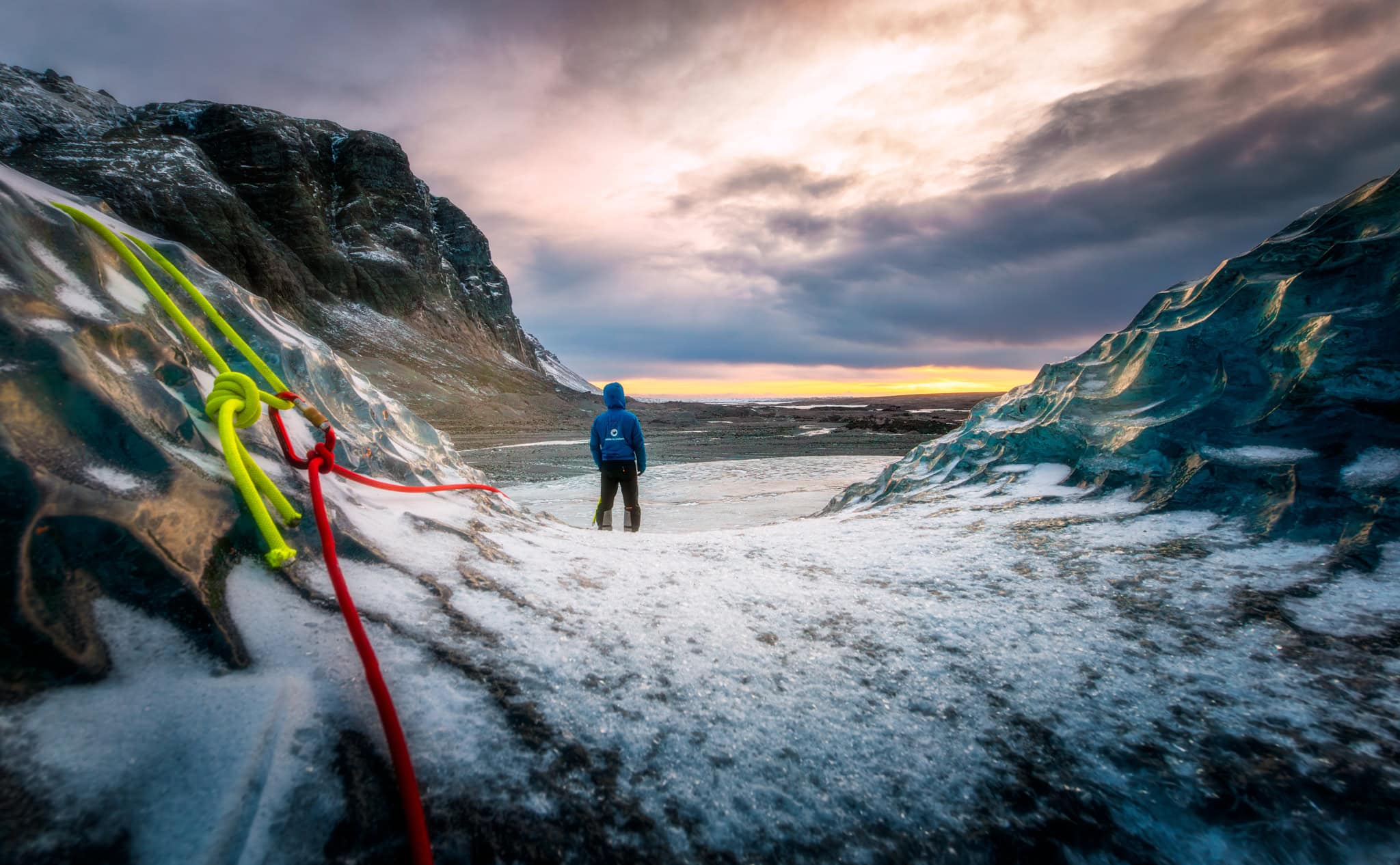
Rule number one with Iceland’s ice caves: you never go alone. A certified guide leads the way – full stop.
We’d just finished shooting inside the ice cave beneath Vatnajökull during our Glacier Tour in Iceland, and it felt like we’d been inside for hours. Time always behaves strangely in these places — the silence, the blueness, the way light folds around the ice like it’s underwater. When we finally stepped back out, the cold hit with a different sharpness, almost clarifying.
To return to the trailhead, we had to climb a small, glassy hump. The guides had already fixed the safety lines — neon knots glowing against the cyan ice — but even with crampons, the surface felt like polished marble.
I hung back for a moment, letting the group move ahead so the frame would clear. When my turn came, the lead guide reached the crest, stopped… and didn’t move. No instructions. No clipped commands. Just a quiet pause.
The glacier seemed to exhale. And the sky — after a morning of steel-grey clouds — pushed a soft orange band across the valley. Our shoot was wrapped. For one minute, his only job was to look.
Of course, I had to capture it — just one more shot.
The ropes lead your eye in, the ice holds it, and then you find him: the guide from @GuidetoIceland, standing perfectly still in one of the most intense landscapes on Earth.
The calm after adrenaline.
That’s what I’ll remember.
(And again: never, ever enter an Icelandic ice cave without a certified guide.)
Glacier Tour in Iceland — What Makes It Special?
Tours into the Vatnajökull ice caves aren’t just “nice to experience.” They’re the only safe way to explore one of the most active glacial systems in the world.
Iceland’s glaciers constantly shift, melt, collapse, and rebuild. A cave that exists today might be gone next week. Certified guides scout, test, and secure routes every morning — something no visitor can ever evaluate alone.
For Max — the photographer who doubts whether he’s “good enough” — this is the kind of place that reminds you: you don’t need to compete with anyone. The landscape does the storytelling for you. Your job is just to be present.
Photographer’s Corner (Short & Practical)
EXIF:
Nikon D850 • 15mm • f/8 • 1/200s • ISO 64
Why a 15mm lens?
Because ice caves are tight. This focal length exaggerates the leading lines of the ropes and ice walls without distorting the horizon too much.
How I exposed it:
The sky was bright, the ice was dark. Matrix metering tended to underexpose the ice, so I dialed in +0.3 EV, then pulled back highlights in post. Shooting at ISO 64 kept maximum dynamic range.
Tip for other photographers:
When ropes or safety gear are in the frame, don’t fight them — use them. They add scale, tension, and narrative. And above all: keep your stance low and stable. Ice is unforgiving.
Vatnajökull: A Glacier That Shapes a Nation
Vatnajökull isn’t just “a glacier.” It’s the largest ice cap in Europe, covering 8% of Iceland. Beneath it lie volcanoes, geothermal systems, and landscapes that shift faster than anywhere else on the continent.
If you want a fun fact for context:
Apparently Iceland is growing by about 5 cm per year due to tectonic drift.
Check out my other blog posts from my unforgetable Iceland tour:
Glacier in Iceland – Finding Scale in a Frozen World Vatnajökull Glacier Tour


