
The Alentejo is Portugal’s largest region, covering nearly a third of the country between the Tagus and the Algarve. Inland, it is a land of wheat, olive groves, cork oaks and whitewashed hill towns. To the west, it also has a long Atlantic coast. Two of its towns, Évora and Elvas, are UNESCO World Heritage Sites.

Mourão and Lake Alqueva
I came to Mourão in July, at the peak of summer. Most travellers avoid the Alentejo then, because the heat is relentless. Our hotel stood on Lake Alqueva, with water on almost every side.
One morning I went out before sunrise. Then I heard sheep bells across a field and followed the sound. A flock was gathered under a lone tree, and Castelo de Mourão stood on its hill behind them. A hot air balloon hung over the horizon, and another one passed above me. So I waited for one sheep to cross the open ground. Its steps kicked up dust, and the low sun caught it.
That frame is the Alentejo in one picture: plains, livestock, a castle on a hill and space. It is not a postcard view. Instead, it rewards whoever gets up first and stays still.
The castle itself goes back to the Reconquista. In 1226, the prior of the Hospitallers granted Mourão its first charter. Later, King Dinis enlarged the castle with three towers. During the 17th-century Restoration War, engineers added bastions, because the town sat close to the Spanish border.
Below the castle lies Lake Alqueva. At about 250 km², it is the largest artificial lake in Western Europe. The area around it also carries the Dark Sky Alqueva label, the first Starlight Tourism Destination in the world. As a result, the nights here are as good as the mornings.
Évora
Évora is the historic heart of the Alentejo. UNESCO lists its old centre as a museum-city whose roots go back to Roman times. Inside the walls, a Roman temple, a Gothic cathedral and whitewashed lanes sit within a short walk of each other. In 2027, Évora is also a European Capital of Culture.
From Lisbon, it is about an hour and a half by car on the A6. For that reason, it became our weekend escape whenever we needed to clear our heads.
Chapel of Bones in Évora
The most famous room in Évora is the Capela dos Ossos, beside the Church of São Francisco. Franciscan friars lined its walls and pillars with the bones of about 5,000 people. The remains came from the town’s old cemeteries. Above the entrance, an inscription greets you: “Nós ossos que aqui estamos pelos vossos esperamos”. In English: “We bones that are here, for yours we wait.”
We had visited the ossuary in Kutná Hora in the Czech Republic, so we expected something gloomy. However, the Chapel of Bones felt calmer. Partly, that came from the light falling in from the side. Our guide explained the rest. According to him, the friars never meant to frighten visitors. Instead, they wanted people to think about how short a life is.

For the photo, I worked from the corner. That way, the gilded altar and the bone-covered pillar share one frame. Since the room is small, you need a wide lens. Also, expose for the bright altar, not the dark walls.
Convento do Espinheiro
Just outside Évora, the Convento do Espinheiro is now a five-star hotel. Its story starts with a legend. A shepherd is said to have seen the Virgin Mary above a burning thorn bush, an espinheiro. Soon pilgrims followed. Then, in the 15th century, a church and convent rose on the spot.
Monks of the Order of Saint Jerome lived here for centuries. Moreover, the kings of Portugal stayed often. In 1481, King João II even held the Cortes of Évora here. Later, in the 19th century, the monks left and the building fell into ruin. Now it is restored, and guests sleep in the old monks’ quarters or the royal rooms.

We stayed there many times, always in the old quarters. On one visit, I noticed the light at breakfast and the cloudless sky. White walls against that blue sky were the shot. So I spent the morning on a series of the Convento do Espinheiro. It runs from the gate to the church and the old wine cellar.

The convent church is still kept in very good shape. In fact, the painted vault and the gilded altar are the reason to step inside.

The library is my favourite room in the building. Look closely at the paintings on its walls: every portrait is of a dog.

After dark, the place changes completely. Floodlights warm the granite pillars of the cloister, and the bell tower glows above them. That is the frame of the Espinheiro Convent at night, symmetrical and very quiet.

Elvas
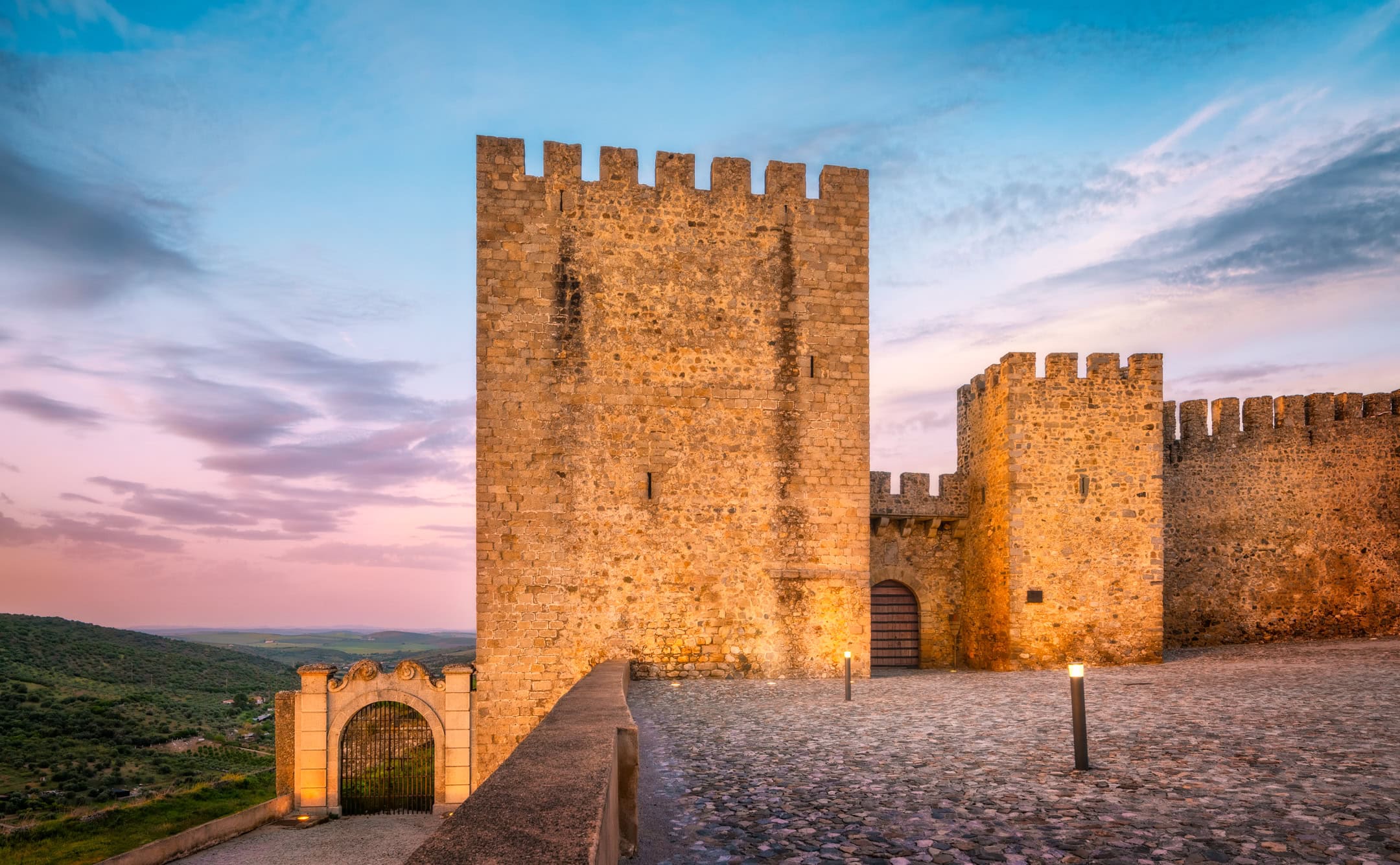
East of Évora, right on the Spanish border, Elvas is the Alentejo’s fortress town. Its star-shaped ramparts, forts and aqueduct form a UNESCO World Heritage Site. I cover it street by street in my Elvas travel guide, so here are the essentials.
Most drivers enter through the Porta da Esquina, a single-lane gate with a sharp turn inside. At the centre lies Praça da República, paved in three colours of calçada. Above it stands the former cathedral, with its fortress-like tower. Nearby, the Manueline pillory is worth a visit at blue hour.
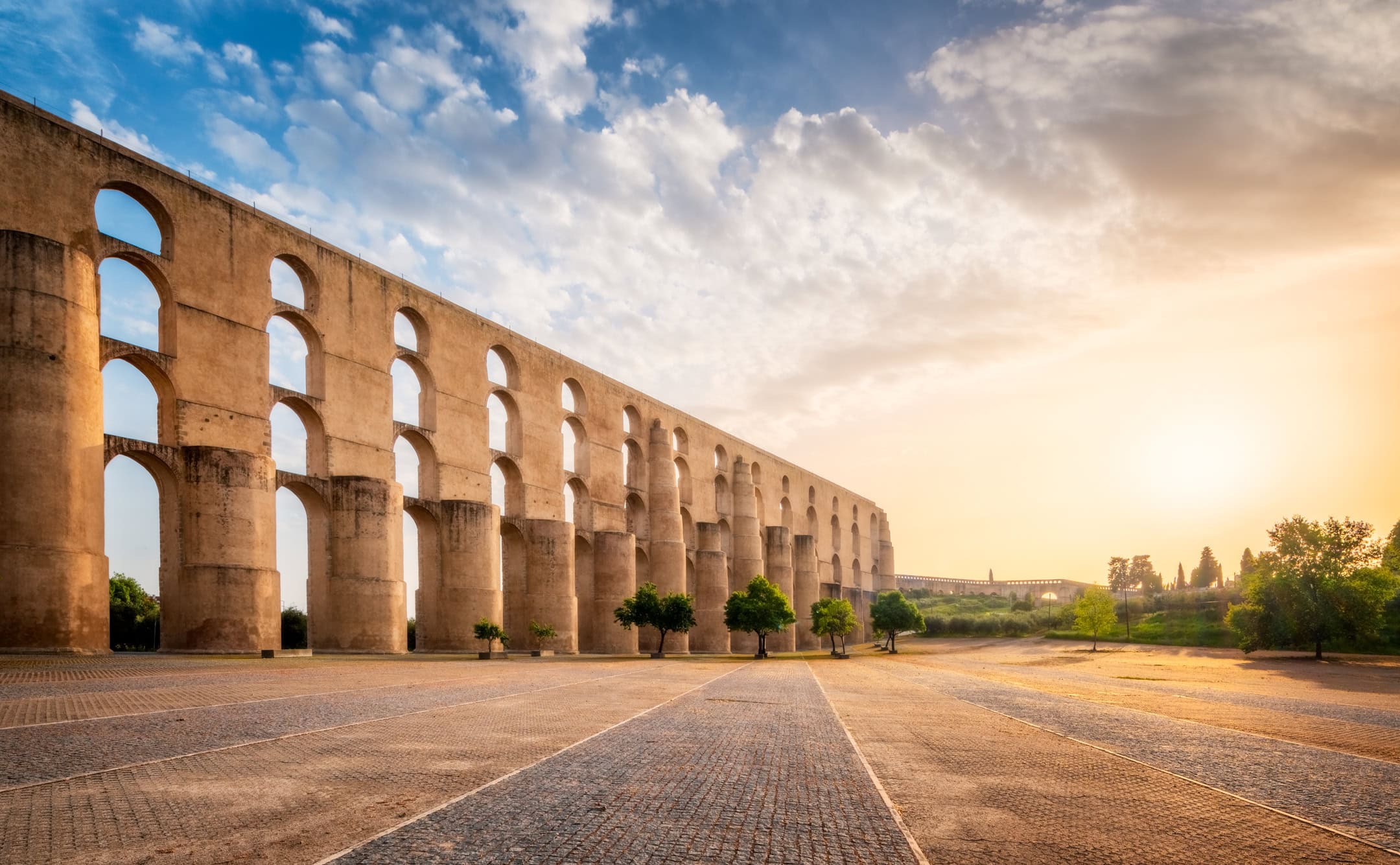
Higher up, Elvas Castle watches over the olive country towards Spain. Outside the walls, the Amoreira Aqueduct carries water to the town over about 7 km. Give it a whole late afternoon, because one frame cannot hold it.
Campo Maior and the Festas do Povo
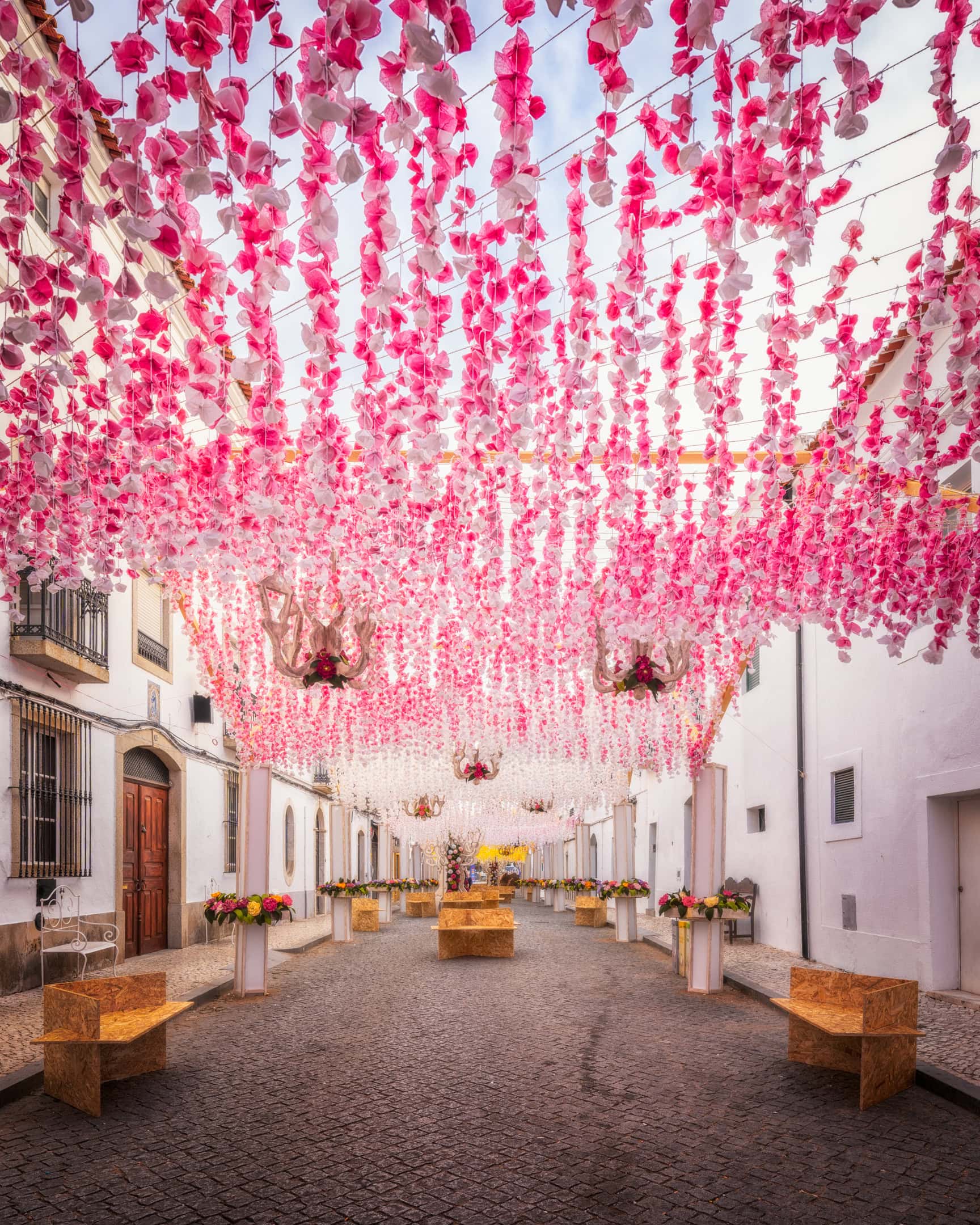
A short drive north-east of Elvas, Campo Maior keeps one of the rarest traditions in Portugal. During the Festas do Povo, residents cover their streets with paper flowers. They fold hundreds of thousands of them by hand over months. Each street keeps its design secret until the night before the opening.
The festival has no fixed date. Instead, it happens when the town decides it happens, and the edition before 2026 was eleven years earlier. In 2021, UNESCO inscribed the community festivities in Campo Maior on its intangible heritage list.
I photographed the Festas do Povo in 2026 on a street that was still empty. As a result, the canopy runs its full length, deep pink overhead and fading to white at the far end. So if a new edition is announced, go early in the morning, before the crowds.
Alcácer do Sal and the Alentejo Coast
The Alentejo reaches the Atlantic along the Sado estuary and beyond. Alcácer do Sal is the first town you meet on the way south from Lisbon. The Romans called it Salacia, after the salt that was produced here. Later, under the Moors, it became one of the great fortresses of the peninsula. Today, its castle is a pousada, a hotel in a historic building.
We were only passing through, but the riverside stopped us. In the morning, Alcácer do Sal on the Sado River reflects in still water. Meanwhile, the castle hill rises above the white houses.

Further west, the Tróia peninsula closes the mouth of the Sado. In winter, its beaches are empty and the water is turquoise. From our room, we watched the sunset over Tróia behind the Arrábida hills. For that side of the estuary, see my Setúbal guide.

Photographing the Alentejo
The Alentejo is not a region of famous viewpoints. Instead, its pictures come from details. Think of dust in low light, a flock on the move, a white wall against a blue sky. Therefore, plan less and walk more.
First, own the first and last hour of the day. In summer, the midday light is flat and the heat is brutal. At sunrise, however, the plains glow and the air still holds dust and haze. Then, after sunset, the floodlit towns come alive at blue hour.
Second, use the dark. Around Lake Alqueva, the sky gets truly black, so a tripod and a clear night pay off. Finally, look for life in the frame. Sheep, storks and balloons give scale to a landscape that is otherwise very wide.
When to Visit the Alentejo
Spring and autumn are the best seasons. In spring, the fields are green and full of wildflowers. By autumn, the heat has broken and the vineyards are harvested.
Summer is very hot, often above 35 °C inland. If you come in July or August, as I did, work at sunrise and rest at midday. Winter, by contrast, is mild and quiet, and it suits the coast and the towns.
Getting Around the Alentejo
You need a car, because distances are long and buses between small towns are rare. From Lisbon, the A6 motorway runs east to Évora and Elvas, and on towards Madrid. Meanwhile, the A2 heads south past Alcácer do Sal towards the Algarve.
A good loop starts in Lisbon, with nights in Évora and Elvas. Then drive south to Mourão and Lake Alqueva. For the rest of the country, start with my Portugal travel guide.
Frequently Asked Questions
Is the Alentejo worth visiting?
Yes. The Alentejo combines two UNESCO towns, Évora and Elvas, with wide plains, castles, vineyards and an Atlantic coast. It is also far quieter than Lisbon or the Algarve. For photographers, it is one of the most rewarding regions in Portugal. Think of low light over the plains, whitewashed towns and dark skies around Lake Alqueva.
What is the best town to stay in the Alentejo?
For a first visit, Évora is the best base. It has the most sights, the widest choice of hotels and good roads in every direction. From there, Elvas, Mourão and Lake Alqueva are each about an hour away. For a special stay, the Convento do Espinheiro sits just outside the town.
How many days do you need in the Alentejo?
Plan at least three days. Spend one on Évora, one on Elvas and Campo Maior, and one on Mourão and Lake Alqueva. With five days or more, add the coast around Alcácer do Sal and Tróia. Distances are long, so fewer stops with more time at each works better.
When is the best time to visit the Alentejo?
Spring and autumn are the best times. From March to May, the fields are green and full of flowers. In September and October, the heat breaks and the grape harvest begins. Summer is very hot inland, often above 35 °C, so plan sightseeing for early morning and evening.
How do you get from Lisbon to the Alentejo?
The easiest way is by car. Évora is about an hour and a half east of Lisbon on the A6 motorway. Elvas, then, is about two hours away. Trains and buses also run from Lisbon to Évora. To explore the smaller towns and the countryside, however, you need your own car.
What is the Alentejo known for?
The Alentejo is known for its plains of wheat, olive groves and cork oaks. It is also famous for its wine, its pork and bread-based cooking, and its whitewashed hill towns. Besides, it has Évora’s Chapel of Bones and the fortifications of Elvas. Finally, there is Lake Alqueva, the largest artificial lake in Western Europe.
Is the Alentejo good for stargazing?
Yes. The area around Lake Alqueva carries the Dark Sky Alqueva label. It was the first place in the world certified as a Starlight Tourism Destination. Light pollution is very low, so on a clear, moonless night the Milky Way is easy to see. Several local operators run guided night-sky sessions.


