
Estonia is the northernmost of the three Baltic states, on the southern shore of the Gulf of Finland. It borders Latvia to the south and Russia to the east. More than 2,000 islands lie off its western coast. About 1.4 million people live here, and the capital is only two hours by ferry from Helsinki.

Tallinn Old Town
Our Estonia archive comes from three days in May 2026. They were the first three days of a ten-day trip through Estonia and Latvia. Two of those days were in the capital, and the third at the Russian border in Narva.
Almost every trip to Estonia begins in Tallinn. Its Old Town is one of the best-preserved medieval towns in Northern Europe. Walls, towers and red roofs survive largely intact. The town also has two levels. Toompea, the limestone hill, held the castle, the cathedral and the nobility. Below it, the Lower Town belonged to the merchants of a Hanseatic port.
That split still shapes how you photograph the city. From the lower streets, the spires rise above you. From the hill, however, the whole town lies at your feet, with the sea behind it. As a result, all three Tallinn frames on this page come from within a few hundred metres of that hill.
Freedom Square
Freedom Square gave me the first frame of the trip. I arrived on 7 May and took a taxi straight to the hotel. As it turned out, my room looked directly over the square. Below the window, crews were already building the stage for Europe Day on 9 May.
When the light turned golden, I took the camera and crossed the street. At the top of a wide flight of stairs stands the War of Independence Victory Column. It is 23.5 metres tall and built from 143 glass plates. On top sits the Cross of Liberty, a decoration created in 1919 for that war. The column was unveiled on 23 June 2009, which is Victory Day in Estonia.
I placed the sun low on the left, behind the trees on Harju Hill. Then a second sun star flared off the edge of the glass, so the frame carries two. To the right, a row of Estonian flags leads to the tower of Kiek in de Kök. That result is the Victory Column at golden hour.
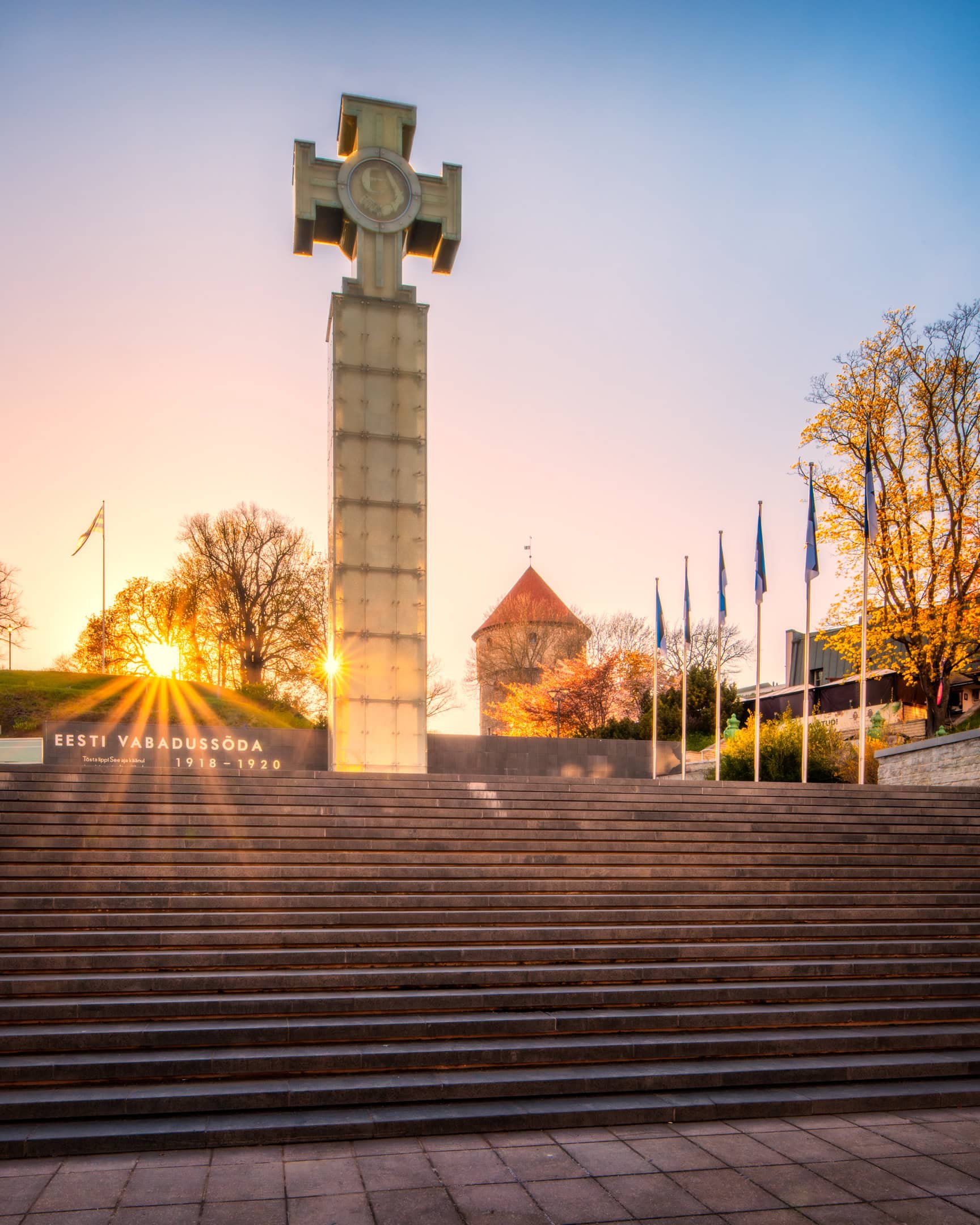
Over the centuries, the square changed its name with every new power. It began as the Hay Market and later became Peter’s Square. In the Soviet years, it was Victory Square. Opposite the column stands St John’s Church, with its neo-Gothic facade.
Alexander Nevsky Cathedral
Twelve minutes after the column, I was up on Toompea. The plan was Toompea Castle, the seat of the Estonian parliament. Instead, the onion domes of the cathedral stopped me first.
The cathedral was built between 1894 and 1900, when Estonia was part of the Russian Empire. Mikhail Preobrazhensky designed it in the Russian Revival style. Its bell tower holds eleven bells, the biggest in the city.
For the composition, I looked for a position where all the domes stand clear, with none hiding behind another. Two more spires frame the church, and the one on the left belongs to St Mary’s Cathedral. Meanwhile, the low evening sun lit the whole facade. That frame is the golden domes of Alexander Nevsky Cathedral. Photography is not allowed inside, so the camera stays in the bag past the doors.

Many Estonians still have mixed feelings about the building. It was a symbol of Russian imperial rule, placed right in front of the castle. Folklore adds another layer, because Toompea is said to be the burial mound of Kalev, the giant of Estonian legend. In the 1920s, the young republic even discussed tearing the cathedral down. However, the plans never went ahead. Its namesake in Bulgaria appears in our guide to Sofia.
Viewpoints on Toompea Hill
Two platforms on the north side of Toompea give the classic view over the city. Kohtuotsa looks across the roofs of the Lower Town towards St Olaf’s Church and the harbour. Patkuli, less than 200 metres away, looks along the town wall and its towers.
On that first evening, I scouted both. From Patkuli, the sun would rise over the bay, beyond the walls. So the next morning, 8 May, I was up at 3:30. The sky was already clearing when I reached the platform.
In early May, the sun rises in Tallinn around a quarter past five. I let it clear the horizon and stand above the water, to the right of St Olaf’s spire. Meanwhile, conical wall towers fill the left half of the frame. On the far right, the TV tower marks the horizon. This is the Old Town skyline at sunrise, the frame that opens this page.
The view also explains the Old Town’s status. UNESCO describes it as an exceptionally complete medieval northern European trading city. It was inscribed in 1997, as the first World Heritage Site in Estonia.
Narva
Narva lies about 210 kilometres east of Tallinn, at the very end of the country. On the Estonian bank stands Hermann Castle, founded by the Danes in the 13th century. Directly opposite rises the Ivangorod Fortress, built by Ivan III of Moscow in 1492. Since 1945, the river between them has divided Estonia from Russia.
I came here for my project Europe Rising, which needed a frame from the eastern edge of the European Union. The date was 9 May. In Estonia, that is Europe Day. Across the river, however, it is Victory Day, marked with concerts, parades and fireworks.
I had spent the evening on the riverbank testing compositions, and I was about to pack up. Then the sky above Ivangorod lit up. The fireworks rose behind the Russian walls, while Hermann Castle stayed floodlit on our side. Below them, the still river held both fortresses and the burst in reflection. That is the night of fireworks over the Narva River.
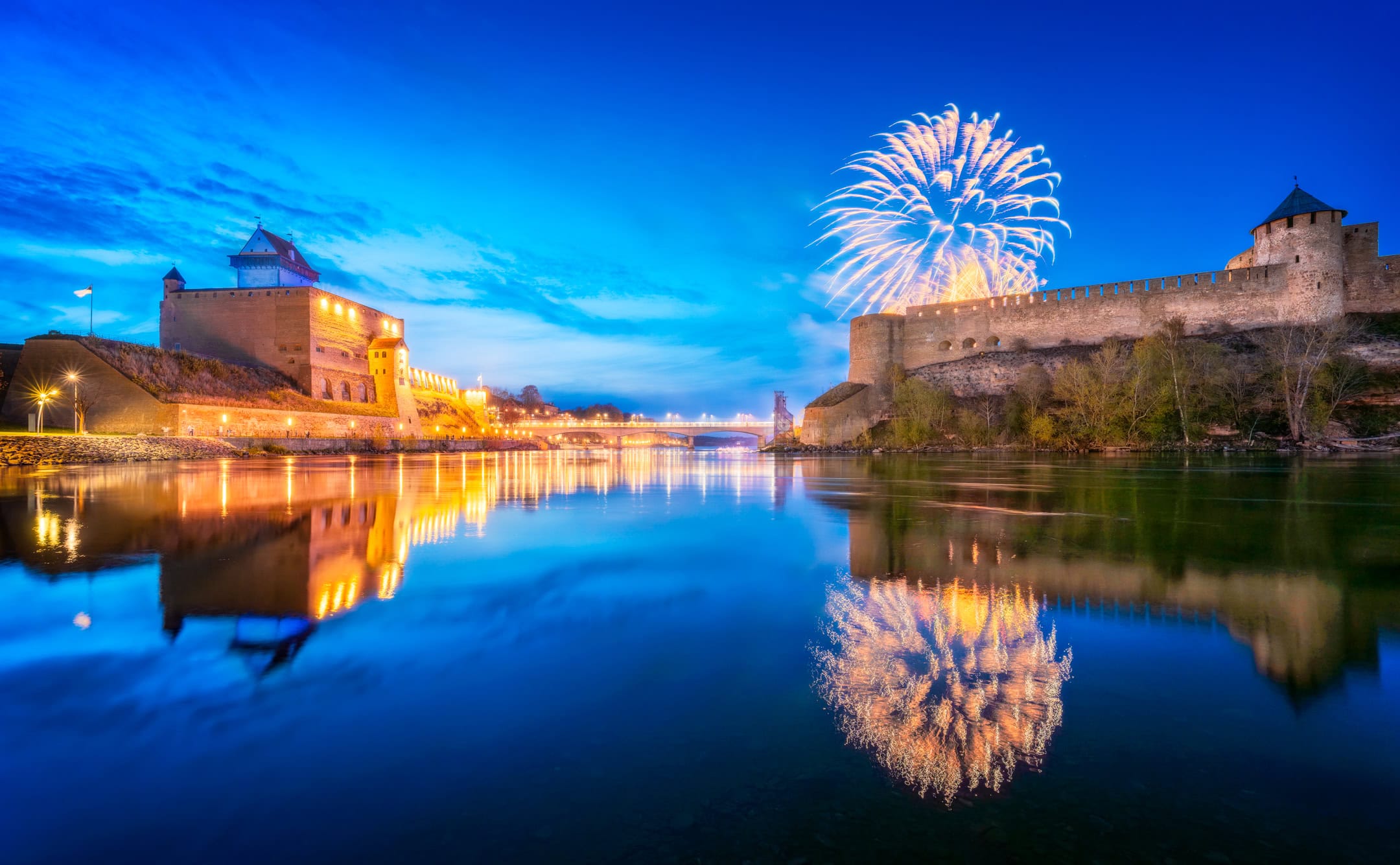
Narva is the third-largest city in Estonia, and most of its people speak Russian at home.
Photographing Estonia
Three decisions carried these three days. The first was scouting the light, not just the place. The Patkuli sunrise worked because I had stood there the evening before and knew where the sun would rise. Without that walk, the 3:30 alarm would have been a gamble.
The second was using the material. Because the Victory Column is glass, the sun flares twice. One star sits in the sky, and the other on the edge of the plates. For that reason, I set the camera at f/22 and moved until both stars sat in the frame.
Finally, the third was knowing the settings before the moment. The Narva fireworks came without warning. The frame is a five-second exposure at f/8 and ISO 100, at 14mm on a tripod. A longer shutter would not have made the bursts brighter, because it only lengthens the streaks. In the end, the castles and the river carry the composition, and the fireworks complete it.
When to Visit Estonia
May and June bring the longest days. In early May, the sun rises around five and sets after nine in Tallinn. By late June, it rises around four and sets after half past ten. Even then, the sky never gets fully dark. Midsummer Eve on 23 June is one of the biggest holidays of the year, with bonfires across the country.
Winter, by contrast, turns the calendar around. In December, Tallinn gets only about six hours of daylight. In return, a Christmas market fills Town Hall Square, and snow often covers the red roofs. Spring and autumn sit between these extremes, with fewer visitors and mild weather.
Getting Around Estonia
Tallinn Airport lies only about 4 km from the Old Town. Ferries cross the Gulf of Finland to Helsinki in about two hours, many times a day. Trains and buses also run east to Narva in about three hours.
After Narva, the trip continued south into Latvia, to the Freedom Monument in Riga at sunrise. Express buses link Tallinn and Riga in about four and a half hours. Further south, our Lithuania travel guide covers Vilnius and Trakai.
Estonia has used the euro since 2011 and joined the Schengen Area in 2007. It is also one of the most digital countries in Europe, so cards work almost everywhere.
Frequently Asked Questions
What is the best time to visit Estonia?
Late May to August brings the longest days and the warmest weather. In June, the sun sets after half past ten in Tallinn, and the night stays light. Midsummer on 23 and 24 June is one of the biggest holidays. December, by contrast, has short days but a Christmas market in the Old Town.
How many days do you need in Estonia?
Two days cover Tallinn’s Old Town at a relaxed pace, including Toompea and both viewing platforms. A week also adds Tartu, Lahemaa National Park or the islands of Saaremaa and Hiiumaa. Narva fits a long day trip from Tallinn, or one night on the way. Many travellers combine Estonia with Latvia and Lithuania.
Is Tallinn Old Town worth visiting?
Yes. The Old Town is a UNESCO World Heritage Site and one of the best-preserved medieval centres in Northern Europe. Most of its walls, towers and street plan survive. It is also compact enough to walk in a day, and the viewing platforms on Toompea are free.
How do you get from Tallinn to Helsinki?
Ferries cross the Gulf of Finland in about two hours, with many departures every day from Tallinn’s Old Port. Several companies run the route, and most of the ships carry cars. Therefore, a day trip is easy. The Old Port is also a short walk from the Old Town, so no taxi is needed.
What currency does Estonia use?
Estonia uses the euro, which replaced the Estonian kroon on 1 January 2011. Cards and contactless payments work almost everywhere, including on public transport. As a result, cash is rarely needed, although a few euros help at small rural guesthouses.
Can you see Russia from Narva?
Yes. The Narva River is the border, and the Ivangorod Fortress stands on the Russian bank, directly opposite Hermann Castle. The riverside promenade in Narva gives a clear view of both fortresses. Crossing the border, however, is a separate matter with strict rules, so check the current situation first.
Is Estonia safe for travellers?
Yes, Estonia is generally safe by European standards. Tallinn’s Old Town stays well lit and busy into the evening. As in any capital, watch for pickpockets in crowded spots and on the main tourist streets. In winter, icy pavements are the bigger risk, so good shoes matter.


