
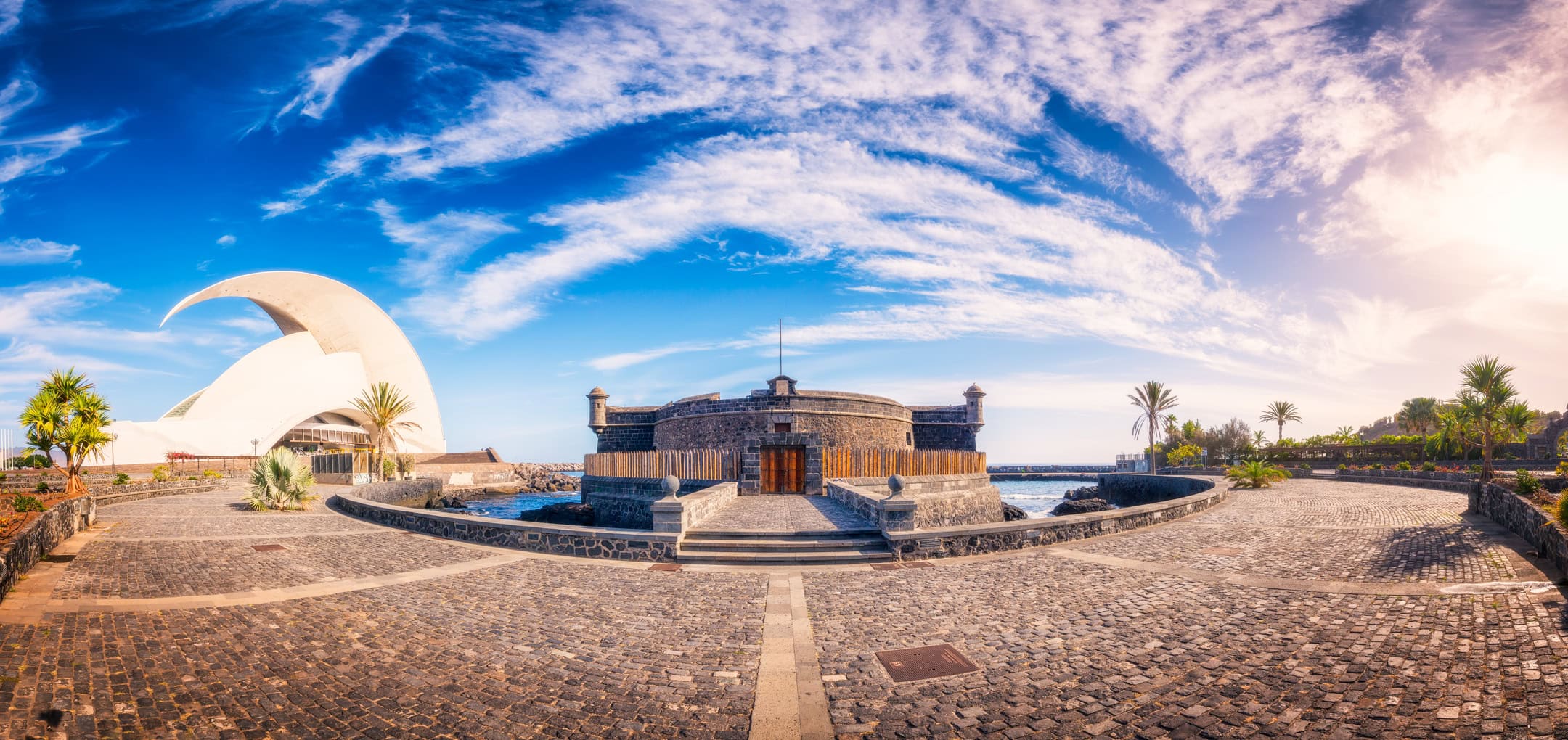
The Castillo de San Juan Bautista is a 17th-century coastal fort in Santa Cruz de Tenerife, popularly nicknamed Castillo Negro, or “Black Castle”.
Even though it looks modest in size, the Castillo de San Juan Bautista was the second most important fort in the defense of the city, after the older Castillo de San Cristóbal. The fortress stands right behind the Auditorio de Tenerife, which is, in my opinion, one of the best representations of modern architecture on the island.
I have to say I found the Castillo Negro a bit intriguing, so I wanted to answer here some of the questions I first asked myself when I took this photo, in case you’re having the same curiosity!
Why is the Castillo de San Juan Bautista called the Black Castle?
The castle was built from dark volcanic stone, a kind of basalt-type rock that was the most abundant building material at the time in Tenerife. So it’d be easy to think that’s where the “black castle” nickname comes from.
However, there’s actually some debate about it, as others say the “Castillo Negro” nickname comes from the site’s location at Caleta de Negros, translated roughly as “black cove” or “cove of blacks”. It’s safest to assume it’s a double reference to both the material and the place.
The stone wasn’t just cosmetic, by the way, as its thickness is a big part of why the structure has survived largely intact for nearly 400 years despite its exposed position. But we can agree the dark tone is still the castle’s most distinctive visual trait.
Can you enter the Castillo de San Juan Bautista?
The Black Castle is one of the best-preserved historic monuments on the island, but today it functions purely as a landmark rather than a visitor attraction and it is not possible to enter the castle.
Even without access to the interior, Tenerife’s Black Castle rewards photographers on its own terms. Its dark silhouette is best appreciated from the outside anyway, especially in this location behind the white curves of the Auditorio de Tenerife and directly by the waterfront.
Is it worth taking a panorama here?
I don’t do panoramas that often, but when I was standing in front of the Castillo de San Juan Bautista, I found the circumstances to fit perfectly well.
First, I noticed the clouds on top of it, and I realized that if I made a panorama, there would be a corresponding arch towards the pathway in the foreground. Also, because the sun and the Auditorio de Tenerife are on opposite sides, it seems like they balance each other in a visual dialog.
I’m not sure if I would have taken a panorama if all those circumstances weren’t there at the time, but that’s how I came to this rather unusual composition with the Castillo Negro wrapped in a circle and framed by the sun on the right and the iconic auditorium on the left. So I’m glad I did it!
Other panoramas I really like include this one of Lugano, because the perspective is a bit unusual, and this panorama of the Teide which is one of my favorite views in Tenerife.
The fort, the Auditorio and the rest of the island are all in my travel guide to Tenerife.


